

Economic Bubbles and Financial Bubbles explained – Definition, Types and 5 Stages
What are Economic Bubbles, and why should we better understand the dynamics?
Economic bubbles have been around for ages. But, what are Economic Bubbles, what types of bubbles are possible, and what stages can be observed over and over again?
Throughout history, some basic human principles have brought us to several inflection points in our economy. Time and again, the perceived value, the price someone is willing to pay for something, far exceeds the true intrinsic value of a good. This is usually shortly followed by a crash and an economic crisis leading to recession and depression.
Even the famous Keynes once mentioned that economic cycles are inevitable and “spontaneous optimism” is in many ways a bigger driver than mathematical rules for the economy. There can be many factors leading to economic bubbles and we will explain the most common types and the usual stages of these financial bubbles.
Index
What is an Economic Bubble?
An economic bubble is a situation in the economy where perceived asset prices and valuations are much higher than the underlying value. The news of price increases leads to an increased influx of new investors who drive prices up and amplify the stories with new success stories until the market value and prices of assets are rapidly escalating. The steep price rise is then followed by a steep decline/contraction as the bubble bursts.
The effects of the bubble is usually only observed after it happened, and so it was also the case for the first known economic bubble. The Tulip mania, which led to a steep incline in prices for tulips and a surge in speculations, which then to a giant crash the year after.
Today, another type of bubble is possible, the leveraged bubble, which is fueled by easy credit. In leveraged bubbles, people lend money and speculate on assets, which leads to a leverage effect of their own capital. Leveraged bubbles are more dangerous to the economy because they have more far-reaching effects on the entire financial industry, not just the speculative bubble itself.
4 Types of Economic Bubbles
In general, any type of financial asset can be involved in a bubble. But we can distinguish 4 different types that we have learned from the past.
Stock Market Bubble
A well-known stock market bubble was the famous dotcom bubble of the late 1990s. This type of bubble mainly affects equities such as stocks, EFTs and other financial assets linked to companies. It is usually confined to a specific sector (e.g. the Internet industry in the dotcom bubble) and is often fueled by a new technology paradigm or a hyped new business model.
Asset Market Bubble
Other assets outside the stock market can also form an economic bubble. Asset market bubbles can be seen in real estate markets, but also in currencies. In this bubble category can be traditional currencies such as EUR, USD, but also new currencies such as Bitcoin, Ethereum, Litecoin and other cryptocurrencies, but also NFTs.
Credit Market Bubble
When the market for business and consumer loans, dept instruments and other forms of credit is suddenly surging, then we speak of a credit market bubble. This could be corporate bonds, government issued bonds, mortgages but also an increase in leasing and “buy-now pay-later” loans.
Commodity Bubble
Commodity bubbles occur when the prices of traded commodities rise. Commodities include tangible assets and raw materials such as oil, gas, gold, industrial metals, agricultural crops, and even tulips, as in the tulip mania.
The psychology and theories behind Economic Bubbles
There are many psychological factors that lead to the formation of a bubble, and many are still unknown. Many theories are also based on human behavior that we have been able to observe. Here is a list of the most common problems we see when dealing with behavioral finance and theories as to why bubbles can exist in the first place.
- Herd mentality – As humans, we always want to follow the crowd, especially if we hope for a positive expected outcome.
- Short-term thinking – All other aspects are shut out as long as the investor thinks that he can “beat the market”. This also increases the likelihood of high risk-taking investment decisions.
- Hindsight Bias – Investors often justify their decisions based on one or two successful examples in the industry or from history (e.g. Amazon, Bitcoin) while little attention is given to failed investments (e.g. pets.com or many other cryptocurrencies).
- Confirmation Bias & Cognitive dissonance – Humans tend to only hear what they want to hear. Therefore, we surround ourselves with opinions, persons and publications that validate ourselves and our choices. This also stays true for companies – as long as the peers also make it this way, it is ok.
- Overconfidence & “Illusory Superiority” – When we win, it’s talent and when we lose, it’s bad luck. This phenomenon is called illusory superiority and it comes when people have success in a certain topic. The more success they have, the more they attribute it to their own talent and disregard everything else as simply bad luck. This leads to high risk-taking profiles and is also observed when gambling.
- Fear-of-missing-out (FOMO) – The fear of missing something that could make a life better is a big driver of first investors. They hear stories in the market and FOMO is responsible for a big part of the 2nd phase of a bubble – the “Boom” where many new market participants enter the market in the hope for a better future and great returns.
- Greater fool theory – This theory describes aspects of a late-stage bubble. Where people pay huge sums for already overvalued assets and believe that they will find a “greater fool” who will buy it for even more money.
5 Stages of Economic Bubbles
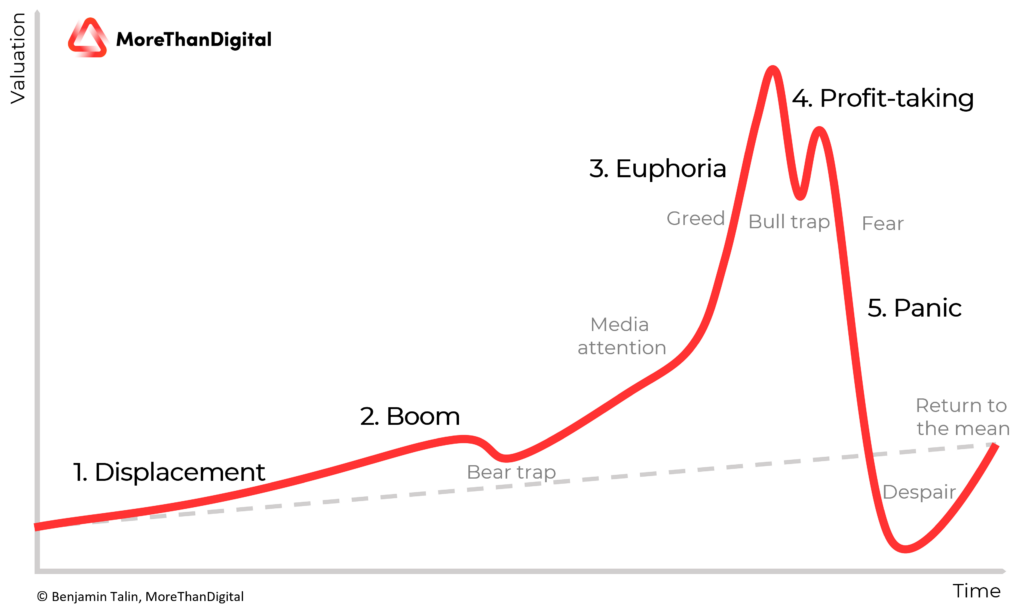
Usually bubbles can only be observed after they have happened, as there are not always clear signs of them. But there is strong evidence that almost every bubble has gone through the same stages. The economist Hyman P. Minsky was the first to outline these 5 stages, so we will explain them in more detail.
1. Displacement
Displacement occurs when investors believe that a new economic paradigm is emerging. This can happen with new technologies, but also with other paradigm shifts, such as low interest rates and large amounts of liquidity in the market.
2. Boom
After the Displacement phase, where markets slowly adjust and slowly rise, comes the Boom phase. This is when many new entrants enter the market and participate in the investment. The widespread media coverage, attention and big promises lead to the so-called Fear of Missing Out (FOMO). This fear of missing out on the opportunity of a lifetime drives many people into the market purely for speculation.
3. Euphoria
In the euphoria phase, we see prices soar. The valuations of companies and assets can be many times their real value. Often new KPIs and measures are introduced to somehow justify that this value must be real. Especially in the euphoria phase, most investors think that they will find someone else to buy the asset at a higher price, making them believe that there is no limit. The theory associated with this phenomenon is called “Greater-Fool”-theory.
4. Profit-Taking
Institutional investors usually get the warning signs earlier and therefore start the 4th phase of the bubble – profit taking and profit taking. Due to the irrational behavior in the market, large investors may also take profits too early and have to hold on to the assets for too long, which diminishes the initial effects, as it is always hard to predict how much overvaluation is still okay and when the bubble will burst. This part will also lead to less trading and more supply in the market.
5. Panic
Once an event triggers the final stage, there is no turning back from the bursting of the bubble. It may be a single event, a single company crash, or some external factors that finally trigger the bubble. Asset prices fall, margin calls force investors to sell, and other factors, including fear of losing money, lead to panic selling of assets. This leads to an oversupply in the market for limited demand, resulting in a steep decline in asset prices and values as there is no “greater fool” to buy the asset at an overvalued price.
Economic Bubble Summary
With many types of economic bubbles throughout history, we see that there is always the potential for a bubble to grow due to our nature. Behavioral economics shows that we follow the herd, we only look at information that we like, and we tend to overlook facts because we are gamers by nature.
This will lead to many more economic bubbles in the future, which will spark interest in a new technology, a new paradigm, and eventually lead to a new economic cycle that starts after the contraction after a bubble. We will see which bubble will form in the future, and most likely we will not see it coming until it is too late. Especially with leveraged bubbles, we will see even greater impacts on our economy, not just for the specific niche in which the bubble was built, as the (financial) economy is more intertwined and interdependent globally. We should also not forget that with fast spreading media news, social media filter bubbles and an increasingly extremist society, we will have a lot of amplifiers that will help fuel new bubbles.



Comments are closed.