

B2B sales are changing – how sales and marketing are winning
Hybrid customer management in B2B: a lot will change.
Marketing is taking on more and more former sales tasks in B2B. This is mainly because sales in the B2B sector is becoming more digital. Personal sales calls are on the decline. B2B commerce is growing. For a consistent customer approach, effective collaboration between sales and marketing is essential. This applies even more to B2B than to B2C.
B2B purchase decision-making processes are significantly more complex than B2C purchase decisions. Understandably so, since the investments are usually significantly higher than for private purchases. And in B2B, several people are involved in a single purchase decision.
At the same time, decision-makers today increasingly want to be addressed digitally on their personal B2B buyer journey.
This article describes the organisational and communicative challenges and the effects of the paradigm shift on the good sales funnel.
Index
Once upon a time: the personal sales talk.
B2B purchasing decisions are complex. We know that. Investment decisions have to be well considered in the current situation. And that by an average of six decision-makers and decision-makers. For example, an average of 6.5 people are involved in IT decisions (Heise, IT decision-maker study, part 3, 2019): the initiators, the topic specialists, the decision preparers, the purchasing department, the decision-maker themselves or the team of decision-makers. The larger the company, the more people involved in the purchasing process. These different people often have different points of contact in the supplier’s sales department during the customer’s decision-making process: the field sales force, the regional sales manager, the internal sales force, the marketing manager, etc.
In the past, the salesperson alone could turn a sale for themselves because they themselves were the brand to the customer. Now the relationship between the salesperson and the corporate brand has been reversed: Gartner’s Future of Sales 2025 report predicts that by the end of 2025, around 80 percent of B2B sales interactions between suppliers and buyers will take place via digital channels.
Digital B2B commerce is currently cited as the preferred B2B sales channel by 35 per cent of respondents to a McKinsey B2B Pulse Survey . Only 26% prefer in-person purchasing. This paradigm shift in B2B marketing and sales has not yet been recognised by many medium-sized companies.
In a hybrid multichannel world, several protagonists of the decision journey must be addressed with different topics as part of a purchase decision process. In other words, brands should communicate in a way that is equally engaging, understandable and at the same time topic- and target group-specific across all (digital) channels.
This also means that a consistent and relationship-oriented brand language is of central importance. The advantages of personal conversations with the field sales force and the charisma of the salesperson are fading into the background. Brands and the contact persons and points of contact involved must simultaneously take into account the tone of different people at the customer with their different needs. And yet speak the ONE brand language.
The future lies in customer management.
We have seen that a large proportion of sales no longer take place in person at the customer’s premises, but either digitally on the B2B commerce platforms with immense growth or as so-called inside sales. In other words, sales from the office, by telephone or by video conference. This large-scale concert of sales activities in different places has a massive influence on brand perception and brand consistency of the selling B2B brands.
The most important principles of perfect customer management are these big three:
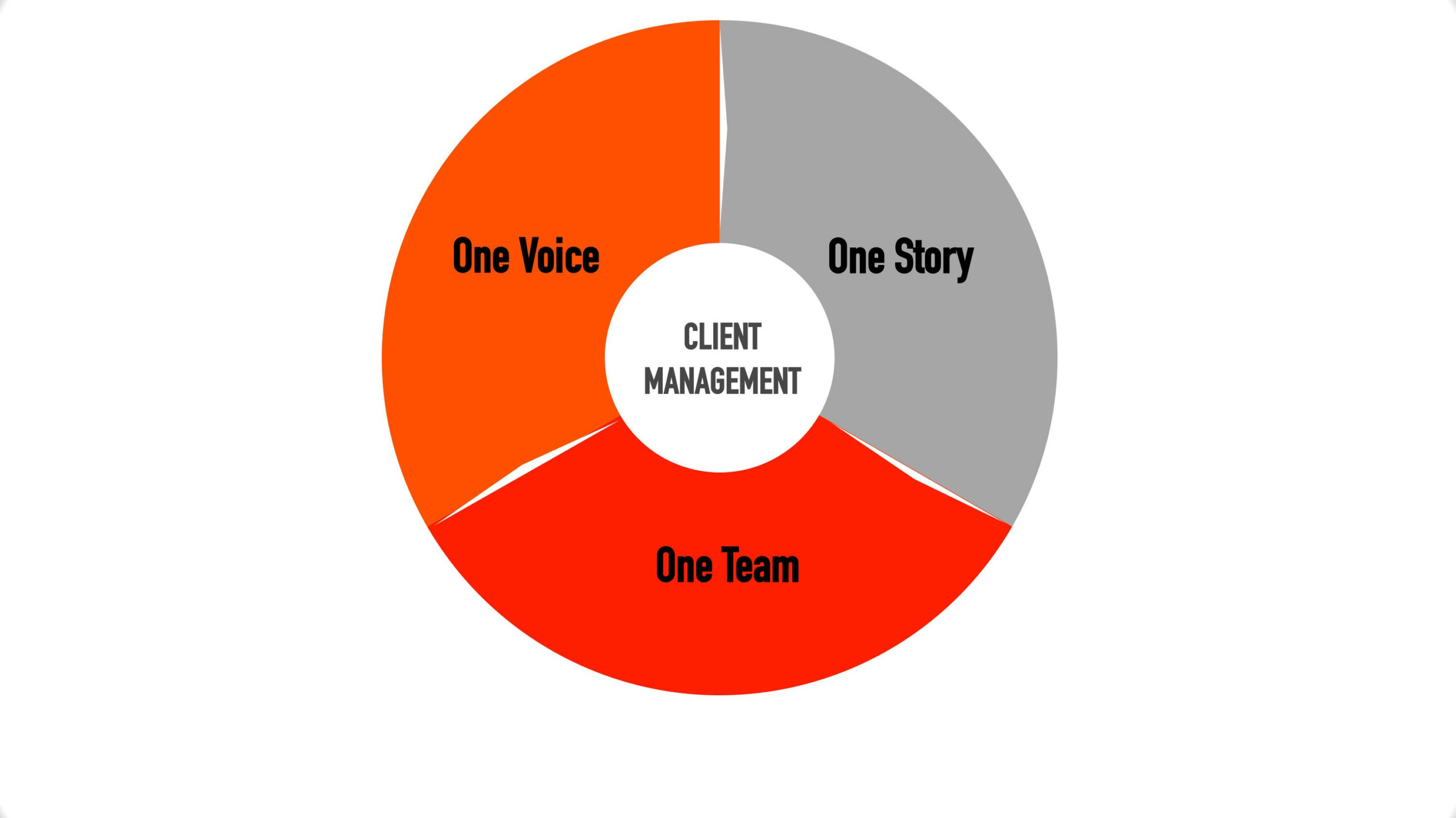
1. One team to customer.
Consistent personalisation and consistency of individual offers across different channels and contact points as a success factor.
For B2B purchasing decisions to be made with conviction, a great depth of information is needed, including benefit-oriented product arguments, price details and scales, information on transport conditions and regulations, ‘due diligence information’, possibly cold chain logistics and storage specifications, and much more. Well, the multi-optional journey of the salesperson is just as complicated as the previous sentence. The use and support of various digital channels leads to increased complexity. Instead of a simple sales conversation from person to person, today there are numerous digital activities that customers engage in on their way to making a purchase: from the first trade fair conversation to email and chat contacts, which lead to remote video sales calls, in-depth content and perhaps finally to the checkout on the B2B e-commerce platform. The boundaries between marketing and sales are fluid.
Maintaining long-term customer relationships in today’s cross-channel sales environment is a challenge that should not be underestimated. Automated e-mails, individual packages when logging in to the e-commerce platform and a personal conversation must be perfectly coordinated. Nothing is worse than a price discussed in a personal conversation that is higher than a price already communicated online three days earlier. Or if an offer has already been rejected by the customer online and three days later the sales department drops by and is unaware of this.
Particularly in B2B, intensive collaboration between marketing and sales teams is therefore necessary. Especially in B2B, the division of sales and marketing will become obsolete in the medium term.
Traditionally, marketing tended to focus on the top part of the sales funnel, while sales tended to focus on the bottom part. Ideally, all stages of the funnel are coordinated together.
CRM systems are traditionally more associated with sales, while marketing automation tends to be more associated with marketing. If both are well connected in terms of processes and technology, the barrier to joint exchange and decision-making is lowered.
Customer management teams are formed, in which different experts sit who complement each other. The close collaboration of experts and cross-channel coordinators and customer experts leads to a transparent level of information and a personalised customer journey without interruption.
How the perfect organisation of a customer management team can be achieved is vividly described in the article ‘Overcoming silos between marketing and sales and making brands more effective’.
In go-to marketing planning, the expertise and experience of sales must also be closely integrated with marketing. Ideally, newly formed customer management teams that communicate the same sales story will accompany the market launch.
2. One story to the customer.
The one customer-specific sales story and no contradictions between the channels and different contact persons are success factors.
Customer expectations and customer satisfaction correlate with each other. It is therefore important to set realistic expectations for purchasing decision-makers in the run-up to the purchase so that they are not disappointed later. Target group-specific communication and storytelling around the needs of customers is of particular importance.
At the end of an initial brand positioning process, there is the brand story, which must also be a sales story. Here, too, the close relationship between sales and marketing is evident. This summarises the challenges faced by customers (insights), their needs, the emotional and rational solution to these, the reasoning behind the Reason Why and the product in a memorable descriptor. The short version of this sales story is the elevator pitch. Every employee in a company should have this at the ready. Then you also know what you are working for every day.
The sales story must be consistent across all channels. It is perceptible in a similar way with every contact. While the charm and personal persuasiveness of the salesperson used to play a decisive role, today the statements of the brand on the digital channels are the measure of all things. It is precisely here that the brand must sharpen its image and consistently orchestrate messages.
3. One Voice to Customer.
Consistent corporate language, formal criteria for addressing customers and tonality as a success factor.
Because B2B is now also predominantly digital, without customers ever speaking to a sales representative in person, personalisation and attentiveness – in other words, dialogue expertise – via digital channels is crucial.
The type of language and the specific tonality are of great importance here. The sales story must be communicated consistently across all (digital) channels in an equally attentive, understandable and, at the same time, topic- and target group-specific manner. Consistent and relationship-oriented brand language is a central element of customer and relationship management.
Companies must therefore compensate for the advantages of personal conversations with the field service and the charisma of the salesperson by increasing the written language and relationship skills.
Outlook: Our shopping carts should get bigger.
In the future, B2B e-commerce will be as easy as a private Amazon purchase. Customers will get used to it. And the inhibition threshold of millions in the shopping cart will be overcome.
Perhaps this will lead to the extinction of the good old handshake after the contract has been signed. Perhaps the trustworthy, reliable word of the sales manager will be replaced by the terms and conditions and delivery conditions listed on the e-commerce platforms.
We have learned that we no longer need on-site meetings as often. In the many video conferences during and after Corona. We no longer travel from Hamburg to Munich for a one-hour meeting. That’s a good thing.
All the more reason for people to network at events and trade fairs and seek personal exchange there.
We should engage much more with the power of (written) language. We should work on forging relationships in the digital space. We should learn how read language and written tonality work – without hearing the sound of the voice. We should also learn to control AI so that we can use it to extend our brand language into digital channels. For example, by means of AI agents and operators, chatbots, in-depth automated product information and process automation that is tailored to the needs and target group.
The boundaries between marketing and sales will become increasingly blurred in the coming years. Marketing managers will have to deal more with sales aspects such as pricing and logistics, while sales managers will be able to benefit from the growing importance of data-driven marketing strategies such as marketing automation and performance marketing. The future could see the emergence of a new type of manager – a versatile expert who combines both disciplines and thus gives companies a decisive competitive advantage. Those who adapt to this development at an early stage can set the course for sustainable success.



Comments are closed.