

AI in marketing requires new evaluation standards
Strategic guiding principles for AI in the brand and marketing context
This article argues for a paradigm shift in the use of AI in marketing: Efficiency should not be the primary goal of AI deployment. Instead, it should be quality. The quality of the customer journey. The quality of the customer experience. The quality of the product. The quality of the service. When it comes to brand experiences, the starting point should always be “strategy first” or “brand strategy first,” not “AI first.”
Lately, there has been a lot of talk in our marketing bubble about digital customer experience, personalized customer journeys, faster purchasing processes in digital shopping, automated customer engagement, speed of adaptation, and increasing content output, and so on and so forth.
Everything revolves around cost savings, acceleration, and mechanization. Efficiency. Boom!
The discussion is largely driven by the current AI hype. And the primary reason for using AI is efficiency. According to the study The State of AI Marketing (The Search Engine Journal, June 2025), 77% of marketing managers surveyed see time savings as the greatest achievement of AI.
But is it really right to see AI primarily as an efficiency booster when we want to automate marketing?
There is a new magic triangle in marketing: people, brand, machine. This triangle is now becoming unbalanced. 78% of CMOs want to optimize their business model through generative AI PWC Pulse Survey, June 2024. More and more control centers in marketing are being automated with AI support. That’s not a bad thing at first glance. But the massive “mechanization” of marketing is developing into a serious threat. The use of AI is becoming problematic because the principles for evaluating it are getting out of hand. Efficiency should not be the primary goal, but rather quality. The quality of the customer experience. Why is this so important? Trust in companies is declining. According to Accenture Life Trends 2025, digitalization is particularly to blame for this.
Before tempers flare, let’s be clear: according to classic business management theory, a commercial enterprise is geared toward maximizing profits. This is even desirable in order to be able to continue investing in innovative products. But making efficiency and profit maximization the primary focus of thinking is destructive when it comes to managing brands.
We expect brands to be customer-centric and at the center of our lives. This means, quite simply, that they should improve some aspect of our everyday lives. The brands that see maximizing customer value as their core business purpose will prevail. Business success will then follow naturally.
Marketing is the customer-centric design and communication of offerings in order to anchor the perceived value, quality, and benefits of a brand in the minds of the target group. And in doing so, to gain their trust in the long term.
If we view brand management in this way, then maximizing customer benefits is inevitably at the top of the agenda.
This way of thinking should shape the evaluation principles for the use of AI in marketing. The ultimate goal of using AI is therefore to improve the quality of the customer experience. Not the efficiency of the customer experience design. That comes naturally.
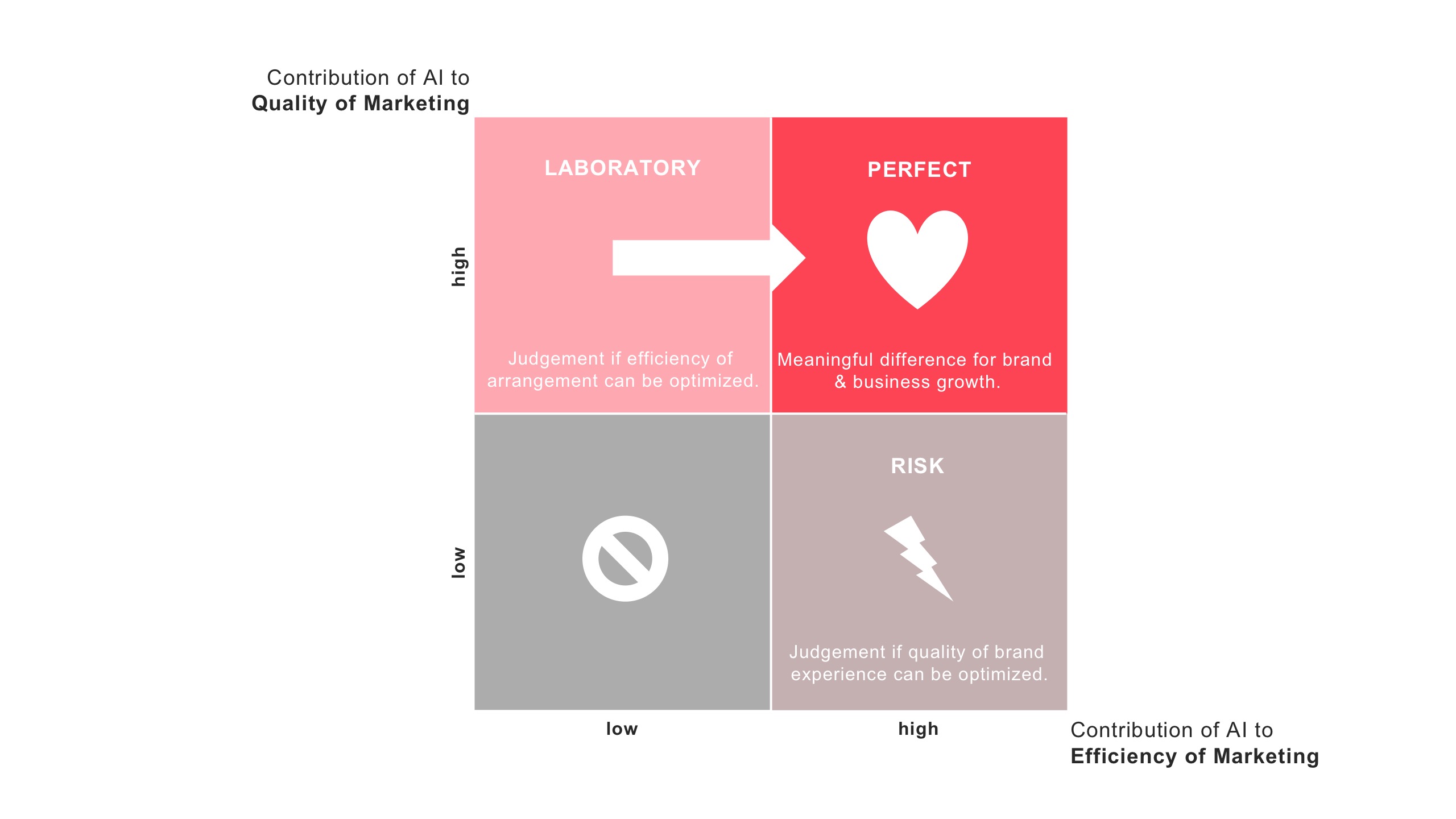
Anyone who sees efficiency as the starting point for all considerations is missing an opportunity. They are even being negligent with their brand.
AI can destroy or strengthen brands, depending on how it is used. Brands must find the right balance between automation and human touch. So where are the potential pitfalls, levers, and solutions for better experiences in the interaction between people, the brand, and AI?
In other words: How can we reconcile customer experience and intended brand experience despite or precisely because of AI?
We can see how this can be achieved by applying the quality improvement template and looking at the interaction between people, brands, and AI from this perspective.
The following target system for quality-enhancing AI use in marketing provides an approach for this.
Index
Four quality-oriented evaluation criteria for better interaction between AI, brands, and people as customers
The new task for marketing managers is to use AI to check whether the quality of customer relationships is improving. Increasing efficiency with the side effect of reducing the quality of the customer experience is therefore a step in the wrong direction.
Excessive automation of customer interaction can make brands appear abstract and unapproachable. Personal, human contact creates closeness and emotional customer experiences. Human attentiveness makes customers feel that they are taken seriously and valued. This alone increases the perceived value of a brand.
This is because customer experience and service emotionality are decisive, differentiating factors in the perceived price-performance ratio. This is particularly important now because consumers are becoming more price-sensitive (State of the Consumer 2025, McKinsey). The reasons for this are increased prices, but also disappointments in brand relationships.
Evaluation criterion 1: Brand fit
When using AI-supported measures, the question is: How consistently does AI support brand identity and brand values? Is the brand perhaps being diluted? Is it being sharpened?
A positive example:
Today, the acquisition and structuring of insights through AI undoubtedly serves to improve knowledge of customer needs and anticipate new consumer requirements. Here, AI can make an efficient and positive contribution to adapting brand orientation and optimizing product innovations.
A negative example:
An AI assistant on the website of a skin care product provider that is designed to help customers find the right product for their skin type and provide appropriate advice is initially a positive development. However, if the tool asks very technocratic or insensitive, direct questions about the customer’s skin type and thus scares the customer away rather than encouraging them to engage with the products, or even overwhelms them with medical jargon, then the AI assistant damages the brand perception.
Today, AI assistants can be fed with the brand’s voice. This creates a corporate language that is consistent with the brand and conveys its values. And the automated help tool is less off-putting and does not destroy the brand. Because it strikes the right tone in the truest sense of the word. The AI assistant then supports the caring nature of the care company by also showing human warmth in its language.
Keyword: human warmth. This brings us to
evaluation criterion 2: Empathy and closeness
A brand understands the needs of its customers. The personalization of the customer journey is currently experiencing a new boom thanks to the use of AI. AI has the potential to predict human needs faster and better during the purchasing process and to adapt communication measures in real time. AI that increases the contextual relevance of brand measures at the touchpoints of the customer journey makes the marketing heart beat faster.
A positive example:
I was very impressed by this true story that I heard recently. What happened? The bank called its customer to ask if he was in Turkey. The customer said no. Major purchases were being made in Turkey using the customer’s credit card. The bank’s AI had detected that these account movements were highly unusual and atypical for the customer’s usual behavior. The AI was therefore familiar with the cardholder’s personal habits. The AI was thus able to prevent fraud. The bank advisor initiated the chargeback.
However, the fact that a human being, namely the bank advisor, called the customer and discussed the next steps with them made the entire process human and therefore very personal, i.e., close. The AI operated in the background. The final, sensitive step was then carried out by a human being. And this small personal act will have greatly increased the customer’s loyalty.
Similarly, it should always be possible to switch from an AI-generated chatbot to a human contact person in the chat at your own discretion.
A negative example:
AI is used today to make the customer journey faster and more personalized. This is a good idea in itself, thanks to real-time learning about the context and needs. However, if prospective customers feel stalked, if all interaction is geared solely toward hard selling and conversion without providing advice or inspiration, then the customer journey is too invasive. It then comes across as threatening or even manipulative. This is off-putting and alienates prospective customers from the brand.
And here’s another negative example: Recently, Prinzenrolle from Griesson – de Beukelaer got itself into hot water. Viewers of the TV commercial for the traditional product felt betrayed and unappreciated. A poorly crafted, cheap-looking AI-generated commercial with an amateurishly integrated Prinzenrolle package heated the tempers of loyal customers. Is that any way to treat a premium brand? Hardly!
Evaluation criterion 3: Transparency
As a general rule, consumers should know whether they are interacting with AI or with humans. It is therefore important to label all AI-supported advertising measures as such. Companies can use AI to manipulate. At the same time, they can use AI to make brands and companies even more transparent.
A positive example:
Generative AI can help to bind customers and prospects even more closely to the brand. It can even turn them into even bigger fans. A GPT fed with company and product data helps users to find out very detailed information very quickly. The prerequisite is that the tool is trained to be truly transparent, i.e., it is also trained with information that may not be entirely positive.
Such a tool is a good aid for products that require a lot of explanation or for capital goods. An insurance company that uses an AI tool to explain in great detail how claims are assessed conveys more transparency than ever before. A call center that uses AI to find better answers to consumer questions more quickly improves service quality.
A negative example:
AI-generated product images that exaggerate product quality and optimize products visually to the point where they no longer have much to do with reality are questionable. The disappointment at the point of sale or when unpacking the ordered product is likely to be great.
You can find out more about transparency and its effect on brand perception here: Transparency is the new currency for brand trust.
Evaluation criterion 4: Participation in the brand and co-creation
One characteristic of successful brands is that people want to get involved and help shape the brand. At the very least with comments, recommendations, and suggestions for improvement. But perhaps even as co-creators.
A positive example:
Unfortunately, Lego didn’t come up with this idea itself: Researchers at Carnegie Mellon University in Pittsburgh have developed LegoGPT. The GPT was trained with 47,000 Lego structures from over 28,000 3D objects and 21 object categories. The GPT is designed to translate the ideas of Lego builders into simple building instructions. For Lego, such a tool would be a positive instrument to enable Lego fans to build their dream objects even better. If the kit for Lego’s building plan were then transferred to an online ordering process, this would create a very personal product experience. In a further step, the best building plans could be included in the standard range.
Here is a demo version of LegoGPT, by the way.
A negative example:
AI influencers are a fun gimmick. But they have nothing to do with the actual intention of an influencer. AI and influencers. They don’t go together. Influencers are partners and co-creators of brands. The influencer in the original sense is a fellow human being who is enthusiastic about topics and products. We believe them because they convey an authentic image of a product based on their personal and conscious experience.
AI is not enthusiastic. AI has no personal point of view. AI has no consciousness. AI influencers therefore reduce the actual added value of influencers to absurdity.
Four quality-oriented evaluation criteria for better interaction between AI, brands, and people as employees
In addition to the customer experience, we should also consider the employee experience. Employees also experience “their” company as a brand. And they do so very intensely from the inside. Up close, practically with an open heart. And if their experiences here do not correspond to the perceived external image, it would be fatal, even destructive for the brand. After all, a company’s employees are its brand ambassadors.
So where can AI help to improve working life and bring it into line with the brand?
Evaluation criterion 1: Brand and cultural fit
As a general rule, even in AI-based measures, the brand itself must speak its own language, share the same values, and be aligned with the company’s mission.
A positive example:
An AI assistant can help employees engage even more with the company. Employees learn more about its history, its successes, and its failures. A brand- and culture-specific AI assistant could be something like an all-knowing almanac for the brand. This enables company members to learn everything they need and want to know: about the vision, mission, culture, values, brand voice, products, target groups, etc. They become well-informed brand ambassadors. The brand manual, including all assets, could also be made available via such an assistant in an efficient and user-friendly manner.
A negative example:
A company automatically sends AI-based birthday or anniversary greetings to its employees. The messages are personalized with names and positions, but the content is generic, full of text modules, and has no reference to the specific role, personality, or team culture.
This is more of a mandatory greeting from the system than a human gesture. Appreciation cannot be experienced in this way. The employee feels like a small cog in a big machine.
Evaluation criterion 2: Empathy and closeness
A positive example:
The positive internal mission statement of continuously developing together and in line with requirements could result in a corporate AI assistant for employee training. This AI coach supports employees in their internal development based on their personal skills, interests, and the corporate strategy. The recommendations are tailored, role-specific, and promote self-efficacy. The coach knows the employee’s skills, develops their strengths, and makes recommendations to minimize skill gaps that may hinder the employee’s further development.
A negative example:
A company is seeing an increase in sick leave and mental health issues among its workforce. To counteract sick leave, it implements an online tool designed to offer solutions or assistance. However, the language of the tool is dry and abstract. Employees sense no nuance, no empathy, perhaps even pressure. This certainly increases rather than reduces their emotional distance from the company. This is undoubtedly the “worst” measure that could be offered. Right now, genuine human closeness and appreciation are what is needed.
Evaluation criterion 3: Transparency
Transparent internal communication is arguably one of the most important functions that a company’s management must fulfill. It can motivate, guide, and track success.
A positive example:
An AI-based career assistant on a company’s job portal can be very helpful for employer branding and for providing information about a specific position. Job advertisements are often not self-explanatory. Applicants frequently do not know how they fit into the company’s hierarchy and structure in terms of content, what the reporting lines are, how large the team is, etc. Applicants could be better qualified if they were able to familiarize themselves with their future role at an earlier stage.
A negative example:
If an internal CEO newsletter about company developments is automatically generated by a GPT, then we probably have the opposite of trustworthy communication. Communication loses authenticity and credibility. The words appear interchangeable and impersonal. There is a lack of human nuance, motivating or comforting words. Transparency has a lot to do with an appreciative attitude, empathy, and closeness. A CEO newsletter written by a bot deliberately undermines employee identification.
Evaluation criterion 4: Participation and co-creation
In an appreciative, open corporate culture that promotes commitment and motivation, co-creation and internal improvement of the company are the ultimate goals. A company’s employees are the key protagonists who drive value creation. In this respect, empowerment and co-determination – not disenfranchisement – are the goal. When introducing an AI-based tool, the question should therefore always be: To what extent does AI support creative and personal development? To what extent does AI support the development of the team and cooperation within the company? How can we strengthen the culture of innovation through access to ideas, knowledge, and perspectives?
A positive example:
A corporation wants to optimize cross-departmental organization and coordination between departments on projects. Collaboration between different groups and departments within the company is currently suffering from a lack of knowledge transfer between units and a failure to disclose all team and individual competencies. A new company-specific AI-based and adaptive application now supports the project teams in coordinating projects and transferring knowledge, and can recommend the assignment of specific tasks to specific individuals and teams. The dashboard always provides a transparent overview of the current project status, the individual activities, and the responsibilities per person and team. This promotes specific collaboration, and the adaptive application also has the potential to anticipate new development steps or plan them better.
A negative example:
You don’t have to be a psychic to know that acceptance of an AI tool will be very low if it is simply introduced without prior notice. If they are not trained. If the objectives and functionality are not explained clearly, openly, in detail, and in a trustworthy manner. And likewise if employees or the team do not have the opportunity to participate in improving the tool.
Transparency and participation are essential when planning and supporting internal AI tools.
The bottom line: Strategy first. Instead of AI first.
AI is causing what is probably the biggest upheaval in marketing and in our working lives. An exciting time lies ahead of us. We are trying out a lot of things. And that is the right thing to do. A company that does not engage with AI is acting with gross negligence. The use of AI means creating value. However, a company that prioritizes efficiency gains for AI is acting just as negligently in the brand and marketing context.
This is because we also have a responsibility to people and brands when using AI in marketing. To people as consumers and employees. To brands as value creators in a world based on the division of labor. As a useful commodity that is supposed to improve the lives of consumers and customers.
The “AI first” strategy approach may be an important impetus to urgently address AI. However, it is fundamentally wrong in the context of branding and marketing.
Strategy first or brand strategy first should always be the starting point when it comes to brand experiences.
So, fellow brand warriors, let’s see AI primarily as an experience architect! And not just as a tool for automation.



Comments are closed.