

Transparency is the new currency for brand trust
Trusting customer relationships in an uncertain world full of misinformation – is that possible?
David Ogilvy coined the following statement: “Great marketing only makes a bad product fail faster.” Meaning: Overpromising cannot make up for underdelivering. Savvy! Smart man. But today, this beautiful statement no longer seems to apply. We are realizing that brands want to improve their products with all their might through automation and AI, even with deep fakes and so-called greenwashing and bluewashing.
Today, we can learn more about products and companies than ever before. We can research online. We can read other people’s product experiences in communities or on review platforms. But at the same time, there has never been so much misinformation. This unsettles consumers. We are losing trust. We have obviously already lost trust in politics. Trust in brands is also suffering greatly at the moment.
This article describes the new currency in marketing: transparency. And how brands can successfully regain the trust and loyalty of their customers.
“You know what you’ve got.” This old advertising slogan for a detergent brand comes from a good, unblemished, truthful world of sales promotion.
Today, we no longer know what to believe. Or who we can believe. We have lost trust in information. We are searching for transparency in the thicket of countless claims. There is no longer one truth. People are bombarded with a wealth of information. They have not learned to process it in such a short time. We limit the flood of information and define our own apparent truth about a company, about a product. And about the statements made about the company and the product. We cannot get to the bottom of all the information. We want to believe. But in this day and age, we can no longer believe. We are confronted with false statements, fake advertising, AI-generated images, and automated dialogues. We can no longer believe everything. And we no longer want to believe everything.
The following figures illustrate this clearly: According to the Edelman Trust Report 2025, the trust index in companies in Germany has fallen from 50% to just 45%. One could therefore say that more than half of what a company says is no longer believed. According to the 2023 edition of the Edelman Trust Report, 79% of global respondents say that trust in the brands they buy today is more important than in the past – an increase of 8 percentage points compared to 2021.
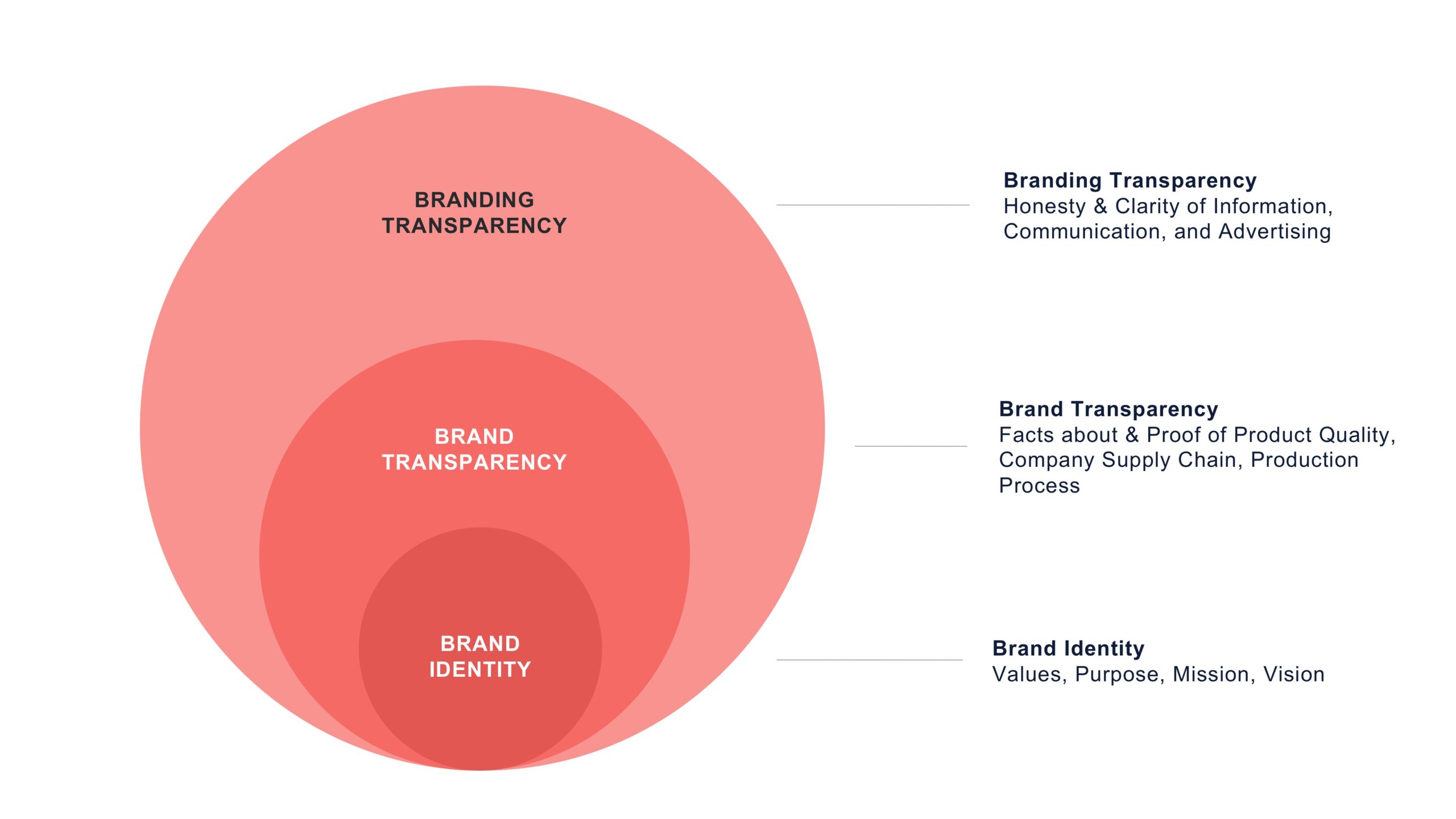
Danger ahead! Trust is becoming the decisive value for customers. Transparency is becoming a value-adding factor for companies. Brands must now do everything in their power to regain the trust and loyalty of their customers. First and foremost with
- honesty and clarity,
- facts and evidence, and
- a clearly defined brand essence.
Index
A. Trust through a clearly defined brand identity.
You know what you’re getting. If the company’s purpose, its big goal, its big task, its attitude, or its claim are not defined, then the solid foundation on which we consumers can build our trust is missing. There is no guiding system that gives meaning to the company’s actions. It is difficult to assess and perhaps unpredictable. It is by no means surprising or unpredictable.
The origin of a brand’s authenticity lies in its brand values, in the definition of the company’s purpose, in the mission to achieve it, and perhaps in the vision to make people’s lives better in a specific area. People live values. People have a vision. People pursue a mission. Not machines. Not robots. Not automated process chains. Not AI. The origin of a brand’s authenticity lies in the brand identity lived by people. This makes it all the more important to communicate this truth clearly and consistently. This is where brand makers take the first step, creating great potential for trust and customer loyalty with a transparent brand. An open and honest brand identity promotes consumer identification. A brand’s lived identity is not Made by AI, but Made by Humans.
Good. Now all that remains is to reinforce and live the brand essence every day with words and actions….
which brings us to the next point:
B. Trust through transparency with facts and evidence (product transparency).
Every brand owner has the purpose of making the lives of their customers a little better, at least in a small way. That should be the minimum standard every brand sets for product quality. So, that’s a good starting point for product development. Well, let’s say minimum requirement. So far, so good. And if the brand company had a genuine commitment and wasn’t just after quick, short-term economic success, then this article would end here.
However, competitive and cost pressures lead to savings in research and development, material procurement, the quality of supplier parts, production, and personnel. Product life cycles are becoming shorter, which is also a sustainability issue. User experiences may deteriorate. But so too may material compatibility, which would have a direct impact on users’ health. Or in the worst case, consumers would be more or less clearly deceived by counterfeit products. The discount retailer Temu, which supports such manufacturers through its sales, operates in a gray area between all of this.
Artificial intelligence can effectively combat deep fakes. Amazon is using AI to declare war on product piracy on its platform. With 15 million products removed from circulation in 2024, Amazon has doubled its success rate compared to 2023. The counterfeit security department is increasingly relying on artificial intelligence in the fight against product counterfeiting. According to the company, billions of data points are collected and analyzed on the platform every day, including IP addresses, logos, search terms, and changes to product descriptions.
Consumers have the right to authenticity and the best quality of a product. This should also include providing information about the quality of the product, how it was manufactured, working conditions, and the supply chain.
The controversial EU Supply Chain Act is an attempt to achieve transparency for consumers and companies. At the same time, it aims to push for compliance with human rights and ESG guidelines. However, the documentation costs for companies are very high.
The independent Stiftung Warentest was founded in Germany in 1964. It was initiated by the federal government under then-Chancellor Adenauer. Products are put through their paces objectively and using scientific methods. Such state-funded testing institutes have become established in many countries. They are an important part of consumer protection.
Unfortunately, accessing this information is not without obstacles, such as costs. Most test results are not freely available, but only for a fee. At the same time, Stiftung Warentest can never claim to test all products and thus provide a transparent overview of all products. This is not possible on the cost side alone.
Brands that independently provide as much information as possible about their products have a clear competitive advantage in today’s world, which seems to be characterized by disinformation. Evidence and tests provided by independent experts complete the transparency of the product.
It should be in a brand’s interest to invest in openness. After all, this added value for consumers is an investment in trust and customer loyalty. This also includes simply admitting that some aspects of the product are not yet satisfactory. And that you are working on it. Fair enough. After all, brands are at the center of people’s lives. And people are fallible. In times of AI and fakes, such an admission is worth money.
The more relevant brands are to consumers, the more customers will participate in product optimization. Often with harsh criticism, but perhaps also with active suggestions for improvement and participation in the development process. Opening up companies to consumers in the form of beta testing, customer workshops, exchange of experiences, and appreciation of dialogue contributes to further product transparency. Brands are not walled gardens, but open systems at the center of their users’ and buyers’ lives.
This means that brands must communicate openly, listen, respond, and provide transparent information. Our next point:
C. Trust through honest and clear communication.
1. Advertising
A brand’s Achilles’ heel is often its advertising. Honest information and clear communication are the be-all and end-all of the relationship between people and brands. The purpose of advertising communication is to present the product in the best possible light. The product is put on a pedestal. And yet, it is important not to gloss over anything unrealistic or sweep it under the rug.
Greenwashing and related practices such as bluewashing, whitewashing, and pinkwashing are on the rise. Companies have recognized that it is precisely these soft factors that make the difference between one brand and another. And that’s where they often go too far.
As a result, legal guidelines are becoming increasingly strict. A German court recently banned Adidas from claiming that the company would be climate neutral by 2050. Well, that’s just a claim and isn’t backed up by detailed measures.
One possible concept for identifying transparent, trustworthy brands is to establish an independent transparency seal. Just as Stiftung Warentest tests product quality, a transparency foundation or transparency TÜV could verify the truthfulness of brands’ claims.
According to Accenture Life Trends 2025, 52% of people have read fake news, 33% have been exposed to deepfake attacks or fraud attempts, and 39% have seen fake product reviews. Based on these experiences, consumer behavior is becoming more hesitant. The criminal use of generative AI therefore creates doubt and mistrust, which delays or even interrupts the purchasing process. This becomes a problem for all brands, even the honest ones.
GenAI can paint a wonderful picture of products and models. If this picture is exaggerated, advertisers pass on embellished misinformation to gullible recipients.
At present, the use of GenAI is not yet comprehensively regulated by law. There is no labeling requirement for AI-generated advertisements. Brands can therefore regain trust by labeling AI-generated advertising as such. And by not exaggerating the product, its benefits, or its effects, and by keeping the presentation realistic. As long as this does not affect the creativity of the storytelling, advertisers are not restricted in terms of content.
AI certainly makes the customer journey more streamlined and faster today because product recommendations, price suggestions, and special offers can be interpreted and targeted even better based on stored purchase history. And all this in real time. Provided that AI does not manipulate consumers in a sneaky way, this makes advertising more relevant and needs-oriented at best. While unintelligent automation is annoying, programmatic advertising is often annoying because it is out of context.
According to a study by Google supported by Boston Consulting Group, AI has increased the marketing performance of AI-leading brands by 60%. The use of Google AI, Google Analytics 4, improved insight analysis, consent mode and enhanced conversions, AI-powered personalization, and GenAI-optimized creatives has not only increased marketing success but also built trust with customers.
2. Product reviews
Product reviews have long been considered a meaningful way to provide prospective buyers with transparent testimonials from real product users. Today, we know that this tool has been quickly abused.
Brands can also gain true trust here and turn customers into genuine advocates for their products if they verify the authenticity of reviews beyond the legal requirements. For example, with the following measures:
- Reviews are only published by customers who have proven that they have purchased the product. Either reviews are linked to the order history online, receipts or invoices prove the purchase, or individual product identification numbers must be provided during the review process.
- Customers receive personalized links for a product review after their purchase.
Independent review platforms could also use a verification system to document the authenticity of users, thereby providing a platform for independent reviews. The existing model of a government transparency register for institutions and companies could also be used as a basis.
3. Personal interaction
Thanks to the immense improvement in GenAI, chatbots are back in vogue with consumers. GenAI-based chatbots can be of great benefit to brands if they have been extensively and intensively fed with the company’s brand and product knowledge. Then they are superior to humans. But can we be sure that AI is not hallucinating? No. And can we be sure that AI wants to manipulate our purchasing behavior? In fact, chatbots are now being equipped with persuasive AI to act as the world’s most convincing sales consultants.
For this reason, personal interaction between people is becoming increasingly important again. Brands that offer genuine conversations on the phone or in video chats demonstrate personal appreciation and, ideally, passionate expertise.
A few days ago, I had a personal experience in an online coffee shop that will definitely make me a few percent more loyal to this e-commerce operator. I mistakenly ordered my coffee as “whole beans” instead of “ground,” as I had intended. I sent the beans back to get the right ground coffee. They contacted me by email and told me that the coffee was unfortunately sold out. However, they still had three packages that were slightly dented. They would charge me the same price and waive the shipping costs. How nice. AI would never have come up with such a pragmatic solution…
An open view of a clear future.
I find the new possibilities of AI phenomenal. I am aware of its enormous potential. At the same time, however, there are dangers lurking.
AI creates fakes. AI suggests ideal material quality and fairy-tale product experiences. AI enables simple personal communication that is not human-made. But sometimes it pretends to be. Sometimes it even manipulates in a subversive way.
And yet AI and automation can lead to greater honesty, security, and transparency. The combination of artificial intelligence and blockchain technology has the potential to make product documentation more user-friendly, less bureaucratic, and easier to use. Blockchain technology can document complete value chains—automatically in conjunction with AI—and record them in a transparent and traceable manner. The information content can be made readable by AI and designed to be visually and textually comprehensible to humans. This gives products a fourth dimension. Background, in-depth information on the value chain, the production process, the ingredients, the materials, the quality grades, the human contribution to the production process, the manufacturing locations, animal welfare, etc., etc.
A perfect central register for products could be created efficiently with the support of AI and blockchain. This automated transparency register could also include consumer reviews verified by blockchain and AI.
And that’s how good AI fights criminal AI…



Comments are closed.