

Brand Choice in the Age of AI – Between Simple Data Logic and Emotional Connection.
On the GEO-logy of brand preference.
AI systems like ChatGPT, Gemini, and Perplexity are fundamentally changing how we discover and perceive brand messages. In addition to issues of machine readability, content formats that list and evaluate product features and functions are becoming increasingly relevant. For this reason, some are now arguing that the brand no longer matters. They claim that the new currency is the product’s hard facts—that is, its functions and features. The article examines GEO and the rational decisions made by AI in relation to brand perception. It answers the question of why emotional brand management is more important than ever.
This fundamental marketing question can really get people worked up! How much emotion does a brand need? Or is it the rational facts that set our brand apart? What triggers the one true impulse to buy? Is it our product’s features? Or is it the emotional brand experience? Is performance marketing the only discipline that matters? Because, after all, it’s what sells! Or is branding the central focus of marketing? Because a brand decision has a lot to do with gut instinct! Marketing colleagues can really get into heated debates about these topics.
And now the discussion is heating up again. Specifically with this topic: GEO. That is: Generative Engine Optimization. SEO is yesterday’s news. These three new letters are the next big thing! Feeds, newsletters, and trade magazines are full of it: GEO and AI-based brand decisions. A new era of marketing has arrived. The end of traditional marketing has begun. Generative AI from platforms like ChatGPT, Gemini, or Co-Pilot lists features, compares product functions, and knows test rankings (listicles). GenAI and GEO are making purchasing decisions increasingly rational because functional facts can be made transparent quickly, deeply, and broadly through AI. We’ve never been able to compare products so easily with so little research effort.
This article aims to get to the bottom of purchasing decisions in the GEO era and answer these questions:
- Do we need to bring more rationality into marketing so that we remain relevant to AI?
- Will future marketing focus primarily on curating product features and functional value propositions?
- Will performance marketing become the most important discipline in marketing for this reason?
Index
“I want to buy a new washing machine. Can you recommend one?”
According to a consumer survey by Ketchum and YouGov from March 2026, 18 percent of respondents say they “absolutely” or “somewhat” trust the answers provided by AI systems when making purchasing decisions. In contrast, only 11 percent trust influencers and social media, and 13 percent trust traditional advertising. This signals a fundamental shift for marketing and communication: visibility at critical purchase moments will increasingly stem not from ads or influencer collaborations, but from the responses of generative AI systems. The purchasing decision process, in particular, is changing significantly. Just under half of AI users (49 percent) use AI tools for product comparisons. 45 percent use them for guidance, 44 percent rely on them for help with the price-performance ratio, and 42 percent research other consumers’ experiences.
Aha. So we marketers can pack it in! Marketing no longer needs emotions. In the future, what’s needed instead are good product managers who perfectly list product features and optimally prepare product arguments for the AI. Marketing is shifting from advertising toward structured information…
Claude developer Anthropic is currently testing a marketplace for autonomous AI agents where AI agents negotiate with one another and shop independently—Agent-to-Agent Commerce (A2A Commerce) is here. The voices are getting loud: If machines buy from one another, then human decision-making is no longer needed. Emotional campaigns are falling flat. The end of psychological marketing is near.
Objection! It’s high time we took a closer look at this. Let’s examine how GEO works and what that means for optimizing visibility in AI-generated search.
How GEO works. Is everything changing now?
One thing is clear: anyone who doesn’t appear in the answers from ChatGPT, Gemini, Claude, or Perplexity loses visibility. We can no longer avoid AI-powered search, even when we use Google. So, brands and products must be captured by generative AI and deemed “relevant.”
While traditional SEO primarily aims for good link rankings in search results, GEO focuses on being directly mentioned in AI-generated answers. To achieve this, the following key points of data structuring must be observed:
1. Machine Readability
- Semantically clean HTML code
- Clear headings and content structures
- Tables
- Structured data, logically organized content with simple sentence structures and clear relationships
- Unambiguous sources, authors, and company information (entities, grounding)
2. Query Fan-Out
The AI breaks down user questions (prompts) into sub-aspects. These are analyzed, broken down, and weighted. This is done based on the model’s knowledge, enriched with fresh data from web searches. In this regard, it helps if brand content is structured simply enough that AI can identify, separate, and generate answers from the sub-aspects of user questions (chunking).
So, just like with SEO, GEO is primarily about visibility. This is also referred to as “Share of Model,” analogous to “Share of Voice.”
In addition to issues of machine readability in natural language processing, content contexts and formats that compare products with others are becoming relevant. Or content that lists and evaluates product features and functions. Currently, formats best suited for AI include FAQs, definition pages, guides/specialized articles, comparison sites, forums & communities (Reddit!), and listicles (What Type of Content Does Google AI Overviews Cite the Most?).
For this reason, some are now claiming that the brand no longer matters. The new currency, they say, is the product’s hard facts—that is, its functions and features.
And this is where the mistake lies. On two levels:
-
- Brand decisions are not based on functional factors. Even when a person makes a supposedly rational decision.
- Visibility in GEO has a great deal to do with brand strength and meaning for people.
Let’s take a look at that now.
Everything remains different: AI is the greatest brand accelerator of all time.
There are four reasons why AI-generated search actually increases the relevance of brand management, making the brand’s emotional experience factors even more important:
- Without a strong brand, there are no mentions, recommendations, or discussions on external platforms.
- “AI visibility” means nothing other than: This brand is highly relevant to people. AI systems “learn” from communities and forums—that is, from what people think about brands. Because if a brand doesn’t appear on external platforms, in third-party articles, in forum recommendations, in Reddit reviews, or in mentions on top lists, then it has little relevance—or intent—for people. And this engagement, regardless of the products’ functional merits, is due to the brand’s image within the community.
- The decision to choose a product is made on a gut level.
- While features and quality form the basis for a brand decision, they are subconsciously overshadowed by the emotional power of the brand. This brand psychology stems from shared beliefs, from the alignment of the brand’s personality with one’s own character and from the feeling that the brand makes my personal life a little bit better. This is certainly personality-dependent, but no one is immune to it. An AI recommendation is not yet a human decision. And people want to decide for themselves. Very emotionally. Even if they don’t realize it.
- The price-performance ratio (PPR) is shaped by brand impact.
- AI increases price transparency. This makes it all the more important to strengthen the brand as the counterpart to the price. Because PLV is, more accurately, a price-perception ratio or a price-value ratio. Perceived value is largely defined by image, by the values, the attitude, and the feeling toward the brand.
- AI-generated preselection makes product search and product selection faster.
- Decisions become more efficient. The customer journey, which no longer exists in its traditional form, is accelerating rapidly. And that is precisely why it is important for emotional brand arguments to become immediately tangible to the decision-maker. The stronger the brand, the more gut-level decisions come into play. The faster the branded product lands in the shopping cart. It is all the better if marketing manages to make an impact long before the purchase decision is made.
The demands on marketing are greater than ever: to own content and communicate the brand through consistent messages, terminology, differentiators, and tone.
The brand must be a powerful pre-impression in the minds of the target audience.
AI will not make purchasing decisions more emotional. On the contrary: it will make them more efficient, faster, and more comparable. And that is precisely the paradox.
Because the more comparable products are, the less they differ. And the less they differ, the more competition shifts toward price.
That is the real disruption: not the automation of the decision, but the economization of interchangeability.
Brand is the only mechanism that can break through this logic.
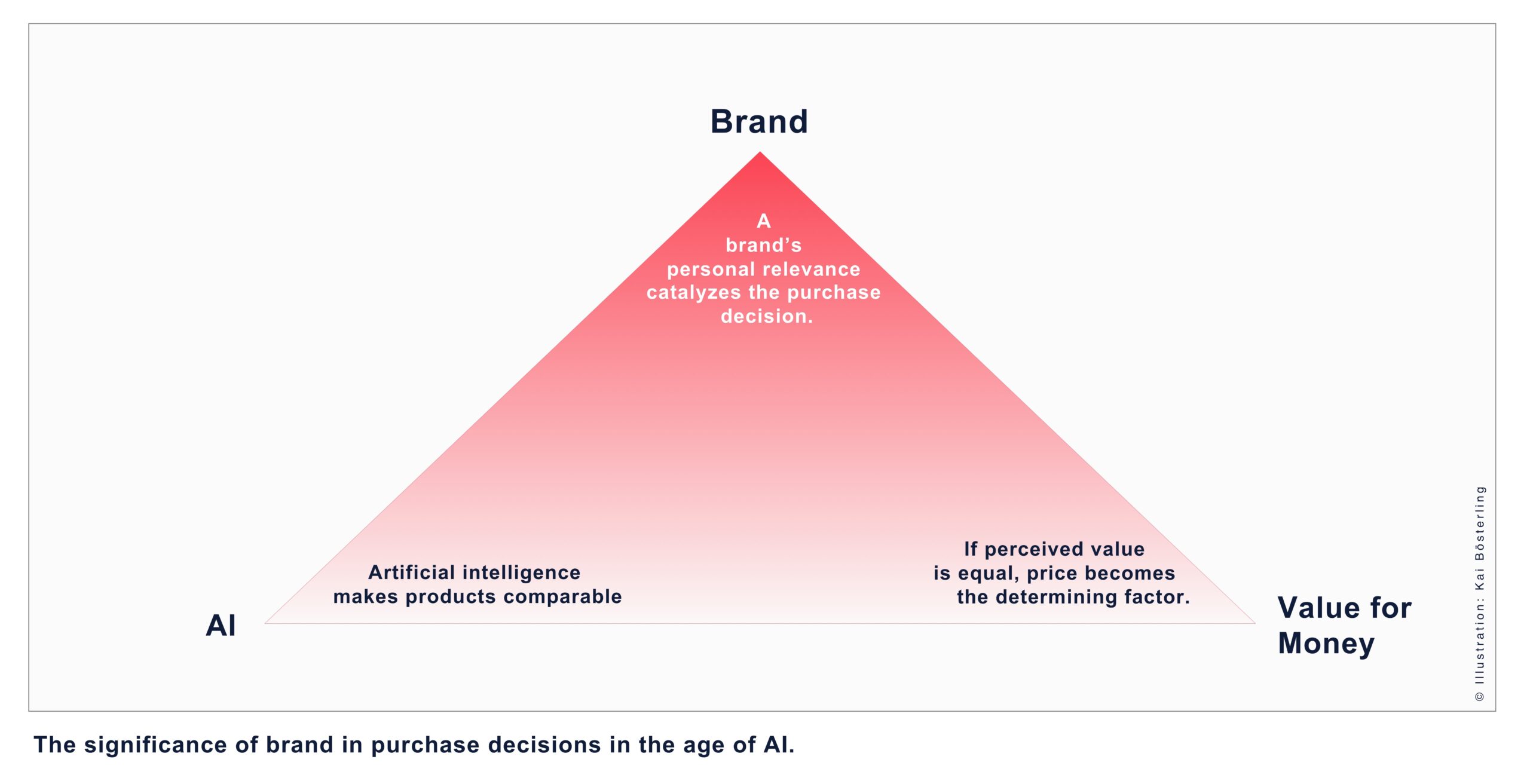
Not because it makes products better—but because it changes what is perceived as value. It translates function into meaning, reduces uncertainty, builds trust, and provides guidance in a condensed, AI-curated customer journey.
Value for money is not an objective measure. It is created in the mind. And the brand is its architect.
The actual task of marketing is no longer to explain products. Rather, it is to give them meaning that remains effective even when a machine explains them. Moving away from persuasion at the moment of decision, toward pre-conditioning long before.
People do not decide solely based on what is spoon-fed to them. They decide based on what triggers an emotional response: security, recognition, guidance, relief, a sense of belonging, or simply the magical feeling of having made the right choice.
Brand management can be most effective in the AI era if we
- translate features into meaning,
- make function and emotion inseparable in storytelling,
- and build memory structures that AI cannot provide.
Note:
AI decides who makes the cut.
Price decides who is replaceable.
And the brand decides who wins.



Comments are closed.