

Change Management: How successful is the constant transformation of organisations?
On the tension between transformation and efficiency.
Companies are having to adapt ever more quickly to the increasing pace of change in the markets. At the end of a change process, there is never a ‘status quo’, because things are always moving forward. This means that structures and processes are constantly in flux. What has been learnt must constantly be unlearned. How is that even possible? This article explores the absurdity of constant change – and how change can succeed in dynamic times.
The current challenge facing businesses: adapting ever more quickly to the dynamics of the markets. The demand: businesses must constantly change. The aftermath of change is already the prelude to the next change. At the end of a change process, there is never a status quo, because the process is meant to continue indefinitely. This also means that structures and processes are constantly in flux. What has been learnt must constantly be unlearned. What has been organised must be broken down. Structure crumbles into chaos. What has been frozen is constantly thawed.
How is this even possible? This article highlights the absurdity of a permanent provisional arrangement as a business model.
The key questions:
- Is change really good for companies?
- Does agility mean ‘organisations in a state of perpetual restructuring’?
- Do customer-centric companies need change management?
Index
1. The ambivalence between organisational change and structural efficiency.
There is no question that innovation and the capacity for innovation are hallmarks of strong brands and successful companies. And when marketing invests in coherent brand management, the foundation for value creation is laid. This is also confirmed annually by Kantar in its BrandZ study. So does innovation and the capacity for innovation mean that constant change management should be the status quo within the company? This is often claimed. The theory of ‘unlearning’ – that is, constantly learning to unlearn in order to embrace new things – suggests that companies must be in a state of perpetual restructuring to be successful. But that cannot work.
Constant change is a theoretical construct. Changed processes, restructured organisational charts and new tools take time. Time that the team needs to work within the new ‘system’. To learn. And to become efficient. Change that is too rapid cannot develop efficient processes and structures.
That is the internal perspective. But we must also consider the company’s external image in the form of brand perception. If the brand speaks a different language to the transformed company, consumers will notice exactly that. And conversely: if the brand already presents itself as future-proof, but the processes and organisational charts within the company fail to keep pace, that is nothing short of disastrous. Brand work is organisational work. And the brand and the organisation must form a single entity. For it is at the intersection of brand and organisation that the greatest value is created. The task of bringing the brand and the organisation together, of rebalancing both anew within a change process, requires time and care. A constant state of change never leads to this efficient and effective unity of brand and organisation.
It therefore stands to reason that companies need a balance between change and stability. They need breaks to establish the efficiency and effectiveness of processes and structures, both internally and externally. They need time to develop the routines for creating value for the new.
2. The more frequent the updates, the worse the operating system.
Mature organisations do not need change management. The more change that needs to be managed, the worse the organisation is designed. The more ‘change programmes’ are necessary, the clearer it becomes: the groundwork, the structures, the processes and the culture have been ignored for too long, and attempts are now being made to repair what has been neglected through projects. To put it provocatively: traditional change programmes are a symptom of not taking day-to-day operations seriously. Even more provocatively: once a transformation process is initiated, it is almost too late. A striking example of this is Deutsche Bahn.
Research cites a “mix of stability and flexibility” as a key success factor – neither constant reorganisation nor rigid adherence works. Change as a permanent state leads to the team becoming exhausted. Colleagues cannot catch their breath; they have no time to get used to the ‘new’ and learn it as a new routine. This ‘change fatigue’ leads to inefficiency. What is needed, therefore, are conditions that are perceived as stable as far as possible.
And yet, a company must demonstrate its capacity for innovation and constantly improve. In a well-designed organisation, the impetus for change arises from the work itself – from customer contact, from day-to-day problems, from the knowledge of the employees. It is, in fact, the small, continuous steps that pave the way for change. It is continuous improvement (as opposed to transformation). And these measures are so small that they are not perceived as change by the people in the organisation. They do not have to unlearn what they have already learnt. They build on what they have learnt and expand upon it.
Continuous improvement is like ongoing training: without it, the company becomes stagnant – but without breaks, it harms itself. Successful companies are those that use stable routines as a source of strength and shape change in a measured, focused and transparent way.
Studies show that successful companies incorporate mechanisms to regularly challenge routines (retrospectives, experimental spaces, rotation, knowledge sharing) so that structures can continuously evolve
Another method considered effective involves creating a small, separate organisational and innovation structure away from day-to-day operations. In “labs”, new ideas are developed without jeopardising organisational processes. Only when an idea is ready for “full-scale operation” is it transferred into day-to-day business. It is important that the labs always approach innovation as small MVPs. Otherwise, the threshold for transformation becomes too high.
3. Change management is an expensive compensation for a lack of customer focus.
A mature organisation generates its impetus for change from within its work – because employees are close to the customer and to the processes. Put bluntly: radical customer centricity renders change management superfluous. Change management thus becomes an admission: “We weren’t close enough to the customer, so now we have to ‘transform’ on a large scale.”
We should view customer centricity as an attitude that is not only meant to be the brand’s North Star, but also a guiding light for the organisation’s implementation of this principle within the company. Structures and processes are not there for the organisation’s sake, but because the organisation wants to serve the customer as perfectly and to the highest standard as possible.
When the mindset within a company shifts towards the primacy of “working for our customers” rather than “working for our organisation”, then continuous improvement – rather than THE ONE big transformation – should be the normal course of action.
If a company truly operates in a customer-centred or people-centred way, change is not an exceptional state, but a consequence. Constant learning from customer feedback, customer data and customer dialogue automatically ensures that processes, products and offerings evolve. In such a system, there would be less need for major transformation programmes, because the organisation is constantly readjusting.
This idea sounds idealistic. But there is an attitude behind it that frequently challenges existing structures and communication within the company. Silos between departments are often the reason why information for improvements – and even vital product knowledge – remains the preserve of a select few. This privileged knowledge and the fragmented communication must then be painstakingly dismantled through a change management process. The impetus comes from outside and is often very painful, not just in terms of costs.
4. “Change from within” taken to its logical extreme.
Constant, lived-out small-scale change does not come from an impulse from above. It can usually only be successful if it is organised independently from within the team, bottom-up, as part of daily work. To achieve this, a company’s management must give its middle management the freedom to act. This means, therefore, that it must relinquish a great deal of responsibility and control. To this end, leadership must establish a culture of empowerment. That sounds easier said than done, because leadership is unfortunately still seen as a tool for steering, control and centralised decision-making. A culture of empowerment requires participatory leadership, a focus on values and goals, trust, flexibility and agility. Agility fails where it is introduced merely as a set of methods – with stand-ups, sprints and boards, but without cultural change.
True agility is an attitude: trust instead of control, a genuine tolerance for mistakes, power-sharing, and real scope for decision-making. As long as these aspects remain untouched, ‘agile working’ is nothing more than well-staged theatre and actually exacerbates change fatigue. Only when agility becomes a fundamental attitude do many traditional change tools become redundant – because the organisation is already in motion. Research confirms that the ability to “self-manage” provides greater motivation for incremental improvement (in line with the corporate vision). At the same time, change fatigue is reduced because the change comes from within (see, for example, the research by the University of Duisburg, 2025).
This means: In a learning culture of continuous improvement, the likelihood of corporate success is higher. The reason: The performance-reducing troughs following a traditional change management phase are much greater and longer than in the agile culture of team responsibility for improvement.
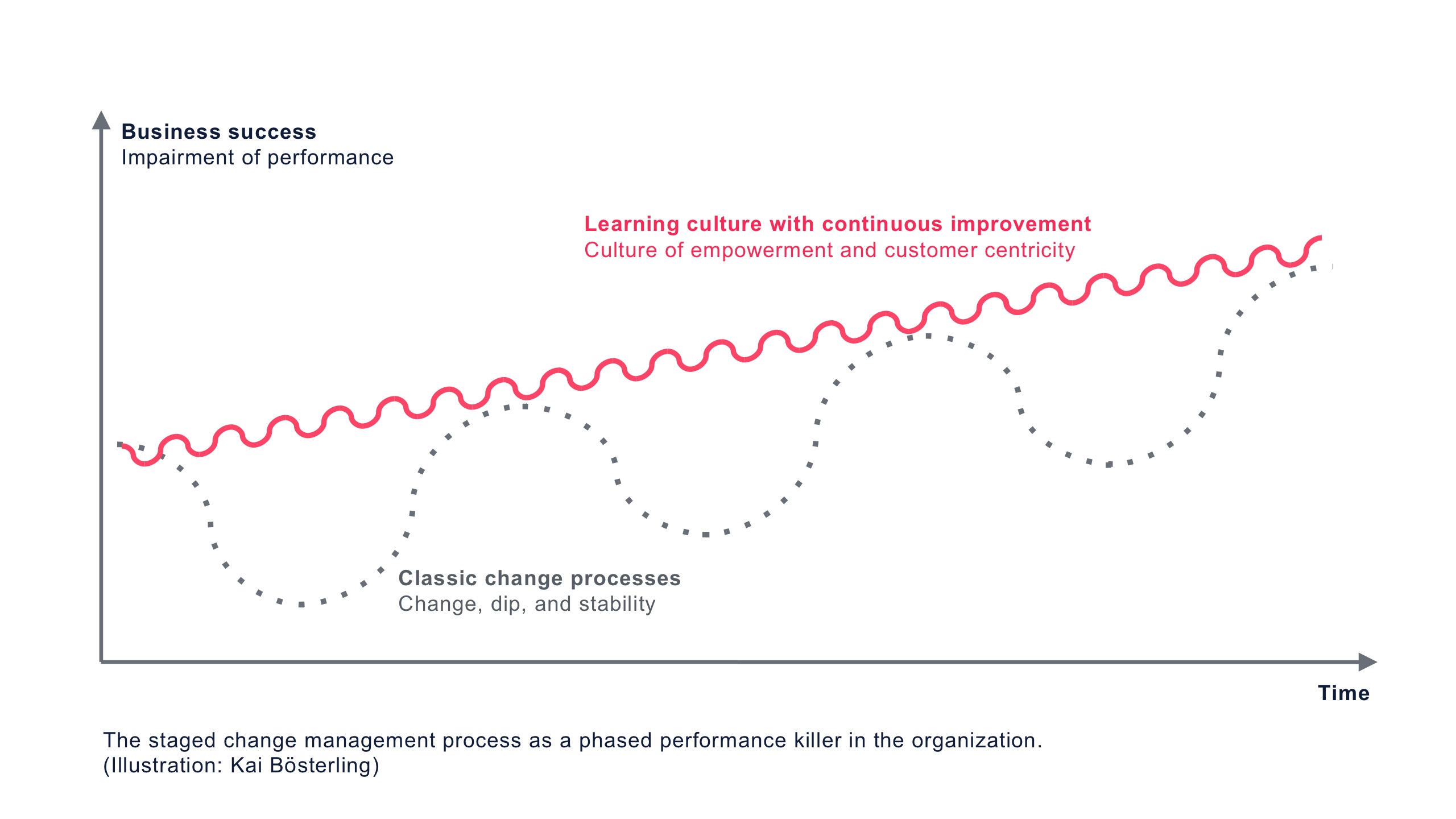
The real solution, therefore, is not change management, but capability management. The major task for leadership in our dynamic times is to promote and consciously embed the adaptability of people within the organisation.



Comments are closed.