

Tokenization of Real World Assets (RWA) Takes Off – Why 2026 Marks the Breakout Phase for Digital Assets like Real Estate
How tokenized real-world assets are moving from experimentation toward regulated capital-market infrastructure - with Europe, and particularly Germany, developing a distinctive framework for digital securities and real-estate tokenization.
Tokenization is rapidly transforming capital markets by bringing real-world assets such as real estate onto blockchain infrastructure. As regulation, institutional adoption and market infrastructure converge, a regulated ecosystem for digital securities is emerging across Europe – with Germany playing a leading role through frameworks like the eWpG. This article explores why 2026 may mark the breakout phase for tokenized assets and what it means for investors, issuers and financial markets.
Index
1. A Silent Transformation Reaches Its Tipping Point

Tokenization of real-world assets (RWA) has been evolving quietly for years – gradually transforming how assets such as real estate, funds or securities can be represented and traded as digital assets on blockchain infrastructure.
Regulatory clarity, institutional commitment, scalable digital infrastructure and a global push for liquidity are converging – forming the foundations of a modernized financial architecture.
Before diving deeper, one short clarification helps: Digital Assets are the broader category of blockchain-based financial instruments, while tokenization describes the process of digitally representing real-world assets – such as real estate, bonds or funds – as blockchain-based tokens.
A detailed explanation of the concept can be found here: Tokenization a Definition
What is entering this architecture today are not speculative crypto tokens, but real-world assets (RWAs) – instruments with intrinsic value that institutional investors, asset managers and real estate operators already understand.
Among all RWA categories, real estate stands out: vast, capital-intensive, slow to trade and constrained by fragmented registries and analogue processes.
Tokenization directly addresses these frictions by:
- reducing transaction costs
- accelerating settlement
- enabling fractional ownership
- opening access to liquidity
– for an asset class historically defined by its illiquidity.
One important clarification for the European context:
In Europe (and most jurisdictions globally), the property itself is not tokenized – land registries remain unchanged. Instead, economic rights linked to the real estate are represented digitally, typically via corporate structures or regulated financial instruments.
I explain this distinction in more detail here: Real Estate Tokenization and the Ownership Illusion
“Tokenization is the process of converting ownership rights or economic interests in real-world assets into blockchain-based digital tokens.”
Unlike cryptocurrencies such as Bitcoin or Ether – which are native digital assets and not representations of underlying real-world assets – tokenized assets derive their value from the underlying real-world assets they represent.
In short, the tipping point is not only technological – it is economic.
Real estate is entering a phase where digitization is no longer optional but strategically advantageous.
2. From Crypto Hypes & Winters to Integrated, Regulated Capital Markets
Tokenized RWAs have grown nearly 500% since 2022, reaching roughly USD 30 billion on-chain, with projections exceeding USD 9 trillion by 2030 (BCG / Chainalysis).
Importantly, this growth is not driven by speculative crypto cycles but by structural shifts in regulation and market infrastructure.
Contrary to popular belief, regulatory clarity itself is not entirely new. European frameworks such as MiFID and FinSA in Switzerland have long governed securities markets.
Interestingly, many expected the EU’s MiCA framework to regulate tokenized securities as well. However, MiCA explicitly excludes financial instruments. Tokenized securities therefore remain regulated under traditional frameworks such as MiFID.
What has changed instead is that national securities laws have been modernized to allow digital issuance and transfer of regulated instruments.
Examples include:
- Germany’s eWpG (Electronic Securities Act)
- Switzerland’s DLT Act
These updates effectively place blockchain-based securities on the same legal rails as traditional instruments – something that was not possible just a few years ago.
At the same time, institutional infrastructure has matured significantly:
- regulated DLT trading venues
- compliant broker-dealers
- digital custodians
- transfer agents
- identity frameworks
- lifecycle-management platforms
In the United States, developments such as the Genius Act, state-level legislation and evolving SEC interpretations point in a similar direction.
Together, these developments are shifting the market away from “crypto for crypto’s sake” toward digitized traditional assets – often using compliance-enabled smart-contract standards such as ERC-3643.
More on that here: ERC-3643: The Smart-Contract Standard Bringing Compliance to Real Estate
Globally visible lighthouse projects – such as Dubai’s modelling of property-title processes on-chain – further underline the direction of travel.
Even if most jurisdictions continue to tokenize economic rights rather than replacing land registries, the message is clear:
Tokenization is becoming part of regulated capital markets – not an alternative to them.
BlackRock CEO Larry Fink described tokenization as “the next generation of markets.”
By 2025, this statement already started to feel operational rather than aspirational.
3. Real Estate Tokenization Moves Center Stage – And What It Really Changes
Real estate still represents a relatively small share of the tokenized market today – but momentum is accelerating quickly.
Fractional investment models lower entry barriers.
Digital issuance infrastructure shortens funding cycles.
And regulatory frameworks such as the EU DLT Pilot Regime create environments for compliant secondary trading.
According to Venturebloxx, 2025 (full report here), real estate is among the fastest-growing RWA sectors, with tokenized real estate markets projected to reach USD 1.4 trillion by 2026 – and even if such forecasts prove optimistic, the broader trend is clear: real estate is rapidly emerging as a key asset class in the tokenization landscape.
Why Issuers Benefit
For developers, property owners and asset managers, tokenization introduces flexible and efficient capital formation.
Equity or debt instruments can be issued in native digital form, while fractionalization allows access to broader investor groups.
This leads to:
- faster funding cycles
- dynamic refinancing options
- international investor access
- reduced intermediary costs
The result is a more flexible capital structure within a regulated framework.
Why Investors Benefit
For investors, tokenized real estate opens doors that were historically closed.
Key advantages include:
- lower entry thresholds
- global digital distribution
- compliant peer-to-peer transfers
- optional secondary liquidity
And most importantly:
Liquidity becomes possible for an asset class traditionally locked in decade-long holding cycles.
For a deeper dive into why liquidity is often described as the “holy grail” of real estate finance, see this analysis: Liquidity Is the Holy Grail of Real Estate
Beyond accessibility, tokenization also introduces programmability – features traditional financial structures simply cannot offer.
These include:
- automated distributions
- real-time lifecycle management
- multi-jurisdictional issuance
- digital collateralization
- fractional refinancing
Real estate, once considered static and illiquid, becomes programmable, interoperable and financially dynamic.
4. Europe and Germany: A Quietly Emerging Digital Asset Ecosystem
While global innovation often focuses on the U.S. or crypto hubs, Europe – and particularly Germany – has quietly built much of the infrastructure required for tokenized capital markets.
Germany’s Electronic Securities Act (eWpG) created a legal framework for fully digital securities, allowing blockchain-based issuance without physical certificates.
Across Europe, similar developments are underway.
However, regulation is not entirely homogeneous across EU member states. While common frameworks such as MiFID apply, national implementations differ. This creates a degree of regulatory competition between jurisdictions, with countries such as Germany, Luxembourg and France positioning themselves as digital-asset hubs.
Germany in particular has developed a surprisingly mature ecosystem.
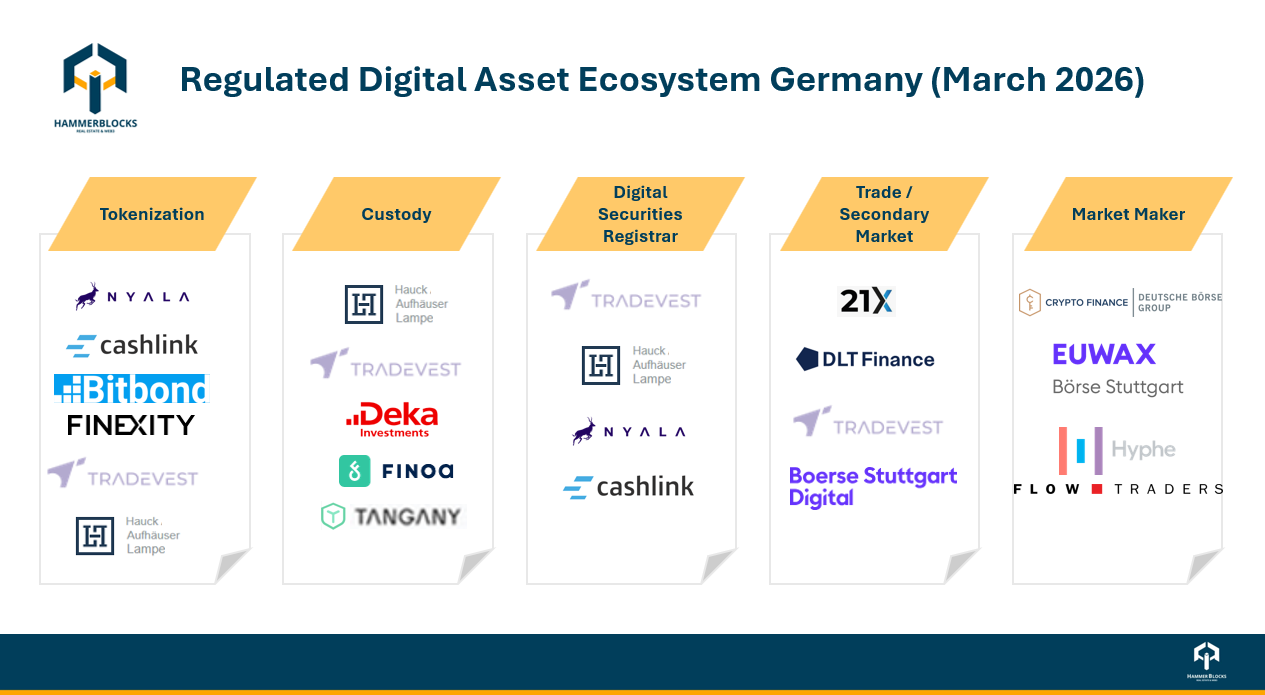
Around digital securities and tokenized assets, a network of specialized actors has emerged, including:
- regulated crypto custodians
- tokenization platforms
- digital securities registrars
- broker-dealers
- legal and compliance specialists
In practice, a regulated ecosystem for digital assets has already emerged in Germany across the key layers of the value chain.
In other words:
Much of the infrastructure for tokenized capital markets already exists – what is still missing is scale.
Liquidity, institutional participation and investor education will determine how quickly this ecosystem moves from technical capability to economic relevance.
Switzerland, with its DLT Act and established digital-asset infrastructure, often serves as a benchmark in Europe – but similar foundations are increasingly emerging across the EU.
Within this broader ecosystem, specialized platforms such as Brickmark X have focused on institutional-grade tokenization of real estate assets under regulated frameworks such as MiFID and FinSA.
The broader trend is clear: Europe is gradually building the infrastructure layer for digital capital markets.
5. The Road Ahead: The Industrial Phase Begins
As regulation, technology and institutional adoption increasingly align, 2025–2026 marks the beginning of the industrial phase of RWA tokenization.
Real estate – long considered conservative and slow to innovate – is emerging as one of the most transformative use cases.
What is taking shape is not a new “crypto market,” but a modernized financial system where traditional capital markets operate on digital rails.
One strong signal of this shift is the involvement of global market infrastructures.
Nasdaq has already begun integrating tokenization into its market technology stack – a development analysed in more detail here: How Nasdaq Is Using Tokenization to Transform Markets
More recently, the New York Stock Exchange (NYSE) has also announced the development of a blockchain-based platform for trading tokenized securities, enabling features such as 24/7 trading and near-instant settlement.
These developments highlight a broader trend: Tokenization is no longer a fringe innovation – it is increasingly becoming part of mainstream financial infrastructure.
The next chapter of real estate finance will therefore not be defined by speculation.
It will be defined by infrastructure, compliance and liquidity.



Comments are closed.