

Value Proposition Canvas Explained
Design value propositions that solve customer pains, create gains, and align with their jobs-to-be-done.
Learn how the Value Proposition Canvas helps align customer jobs, pains, and gains with your product’s role to craft offerings that truly deliver value.
The essence of a business model is how to make money by selling to customers. The core question therein is why a customer would pay for the offering. The answer is that the customer finds the offering more valuable than the price paid for it. For this reason, Alexander Osterwalder has positioned the value proposition at the core of his business model canvas. (Link to Source)
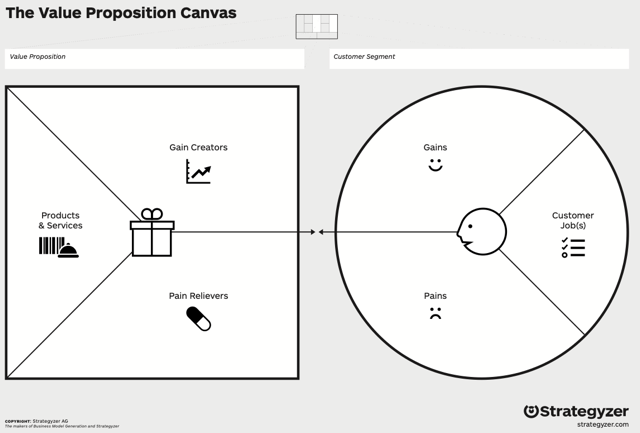
In preparing a business model canvas, it is very often observed that this task is challenging. Therefore, Osterwalder has created another tool: the value proposition canvas.
Index
Value proposition canvas
Job-to-be-done
To build the Value Proposition Canvas, Osterwalder builds on the concept of the ‘job-to-be-done’ (JTBD) defined by Clayton Christensen (Source). Christensen uses the term to describe the product’s function in the customer’s context. On the value proposition canvas, it is also used to describe the customer’s task. What are the tasks the customer has to fulfill to be successful?
As an example, we take a factory (B2B case). The job of the factory is to produce the products. The factory is embedded in the company’s internal value chain. It relies on the jobs of the R&D department to adequately describe the product and the supply chain to provide the material for the production.
Customer stakeholders
If we are selling to a consumer, it is an individual’s job that is described. In a B2B context, the customer may be an organization (company or functions thereof). Still, it may be valuable to break down the organization’s job to the jobs of the individuals involved in the purchase decision.
Gains
To understand the gains in a customer’s job, it’s helpful to ask what success looks like when the job is done well. What benefits does the customer receive from proper execution? These gain areas typically represent the customer’s core competencies. A well-executed job defines success, whether that’s market success for a company or praise and promotion for an individual. By excelling in these gain aspects, customers differentiate themselves in the market.
Pains
The pains in a job-to-be-done are those areas that the customer does not like to do. Any job has fun, enriching parts, and others that must be done to succeed but are not contributing to the gain and are perceived as inutile or even painful.
It is to be noted that even though this is perceived to be painful, the prevention of gain factors is not a good pain point. If we define ‘uninterrupted production’ as a gain enabling more products to be produced, ‘interrupted production’ expresses the same aspect and does not add value to the analysis.
A typical pain point in many jobs is for example reporting. While the person loves the execution part of the job, e.g. fixing machines for a service technician, a detailed and cumbersome reporting protocol needs to be filled out afterwards, a pain that does not generate a gain.
Product’s job-to-be-done
As mentioned before, Christensen defines a product’s job, i.e. rather than describing what a product is, he describes what a product does. Many product descriptions focus on a product’s features, and mostly on its technical features. By expressing the product’s job, the focus is more on the action it performs. From this angle it is much easier to express what problem it solves for the customer. Similar to the customer’s JTBD, we can also explain what is a product’s job well done, and get an idea on how to differentiate, i.e. on how to do the job better than the competition. Since we have identified that a customer’s job has gain as well as pain aspects, we can identify how the product is addresseing these.
Pain relievers
As we discussed before, a customer does not like to execute the painful parts of the JTBD. Nobody objects to pains being relieved. Therefore, if a product’s JTBD is fully executing the painful parts of the customer’s job, this is highly appreciated. If your product not only executes its function, but also provides a report in the format required by the regulator, this relieves one of the customer’s pains mentioned before.
Gain creators
As mentioned, the customer is proud of executing the JTBD well, to achieve gains. Assume, that the customer has spent a lot of time and effort in getting better than competition. The task of your product is to make them even better. Your product shall support the customer in becoming even better.
Lifecycle considerations
Many value propositions describe the product in operation. Faster execution or lower operation costs are often seen in value propositions. However, some of the customer value may be delivered along the product’s lifecycle.
Product installation & configuration
A product may provide many operational advantages. If is very difficult to bring it into operation, these advantages may be diminished. High investment costs are the most obvious factor that is typically considered when selecting a solution from a supplier. But there are other efforts that may prohibit an offering to be brought into use: high installation costs for example, or configuration cost. If a factory is operating, replacing one of the machines in the line may require reconfiguring the line, in some cases even adapting the building. Unless the customer has parallel lines, or different factories, the resulting downtime adds to the cost as well.
This not only holds for machinery. Changing an IT system is difficult as well, since business processes need to be adapted, and data needs to be migrated.
When analyzing the value proposition, the customer’s pains and gains can also be identified in the introduction process. A product that is easier to install has a clear advantage over one that incurs higher introduction costs. This is also a good opportunity to think about complementing services.
Product maintenance & support
Another aspect of the product’s lifecycle to be considered is maintenance and support. No product operates forever. Occasionally it doesn’t, a clear pain point for the customer. To then make it very easy to resolve the issue and bring it back to operation may be a critical success factor in a product’s value proposition. For equipment, this may be diagnostic & monitoring capabilities, repairability, and also service and maintenance contracts.
No customer likes to not be able to perform a job because a supplier’s product or service is unavailable, neither business customers, nor consumers. For business customers good service offerings are essentials, and mostly available. Consumers, however, are often left with little access to support.
Again, maintenance and support excellence mostly addresses customer’s pain points, and should therefore be an important part of an offering. You gain customers with a good product, you lose them with bad service.
Conclusions
Thinking about the job your offering is performing for your customer is essential in designing its functionality – not only in operation, but throughout its complete lifecycle. Being aware of the job the customer is doing with and around your product helps understanding what is really needed. Being aware of what aspects of the job the customer likes (gain) or dislikes (pain) helps positioning you even better. When expressing the value of an offering, it is essential to not describe features and functionality: explain how it adds to the customer’s job by supporting gains, and relieving pains.



Comments are closed.