

Reindustrialisation Is a Policy Trap – Politics is Fighting for the Past
The populist narrative of "bringing back the industry" signifies not merely a political failure but also an economic pitfall.
The biggest policy trap, and perhaps the most costly economic lesson of our time, is the myth of reindustrialization and the policies that promote it.
Every government in the developed world is now telling some version of the same story. “We bring back manufacturing”. “Protect our factory jobs”. “Rebuild the industrial base”. It polls well, it sounds responsible, and it is almost entirely wrong – on so many levels. And I know it as I have now advised almost every major economy in the world and was tasked to help them with their reindustrialization, FDI or other measures to attract manufacturing.
The story rests on a fundamental economic misunderstanding of what actually happened to manufacturing (and industrial policy in general), and that misunderstanding is now driving billions in public spending toward a destination that does not matter anymore. Before a single policy is defended, the numbers have to be put on the table, because most of the debate is conducted without them and only based on feelings, on fear and on media attention given to the person that screams the loudest for political failures for losing jobs – but in the end it is just a natural evolution of the economy and it happens in every country in the world.
Index
The peak already happened, and it happened a generation ago
Manufacturing as a share of GDP did not collapse recently. It peaked decades ago and has been declining ever since, in every advanced economy, without exception.
Just take the example of Germany, manufacturing value-added peaked at roughly 25% of GDP in 1991 and sits at around 19% today. In the United States it peaked far earlier, at roughly 28% of GDP in the early 1950s, and is now lower than 10%. The United Kingdom ran above 25% in the early 1970s and is now at roughly 9%. Japan held one of the strongest industrial bases in the world and still declined into the high teens. I guess the chart below tells the story very well and even China is losing jobs in manufacturing in the millions.
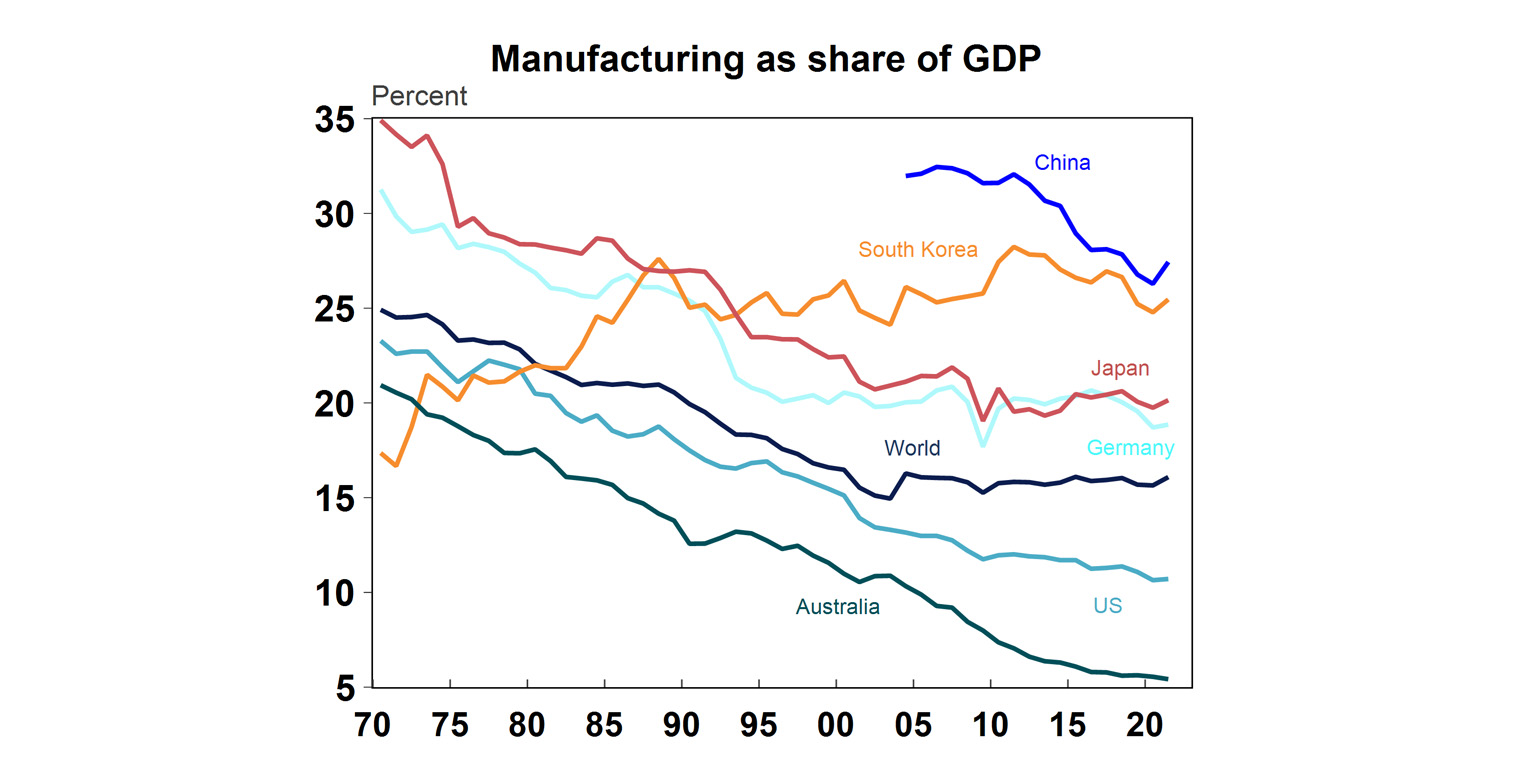
The data lines up too cleanly to be coincidence:
- Germany: peak ~25% of GDP (1991), now ~19%.
- United States: peak ~28% (early 1950s), now ~10%.
- United Kingdom: peak above 25% (early 1970s), now ~9%.
- China: peak ~32% (2006), now ~25% and falling.
- Globally: manufacturing has fallen from roughly 27% of world GDP in 1970 to under 16% today.
These are not failures of policy. They are the same curve, repeated across every country that industrialised. The decline is structural, not circumstantial, and no amount of national willpower has reversed it anywhere. But somehow still everyone wants to jump on this narrative despite forgetting the overall evolution.
Every one of these economies is on the same downslope. The richer and more advanced the economy, the further along the curve it sits. There is no example, anywhere, of a developed economy reversing this. The countries that have “defended” manufacturing best, such as Germany, South Korea and Japan, have merely declined more slowly. They have not turned the curve around.
When a politician says Germany or USA (or whoever) lost hundreds of thousands of manufacturing jobs, the correct response is: so did China. Job loss in manufacturing is not a symptom of decline. It is a symptom of productivity. The same thing happened in agriculture, and we correctly understood it then as progress.
Agriculture already taught us this lesson
The fun thing is that we have seen this exact pattern before, and we should have learned from it.
In the 19th century, agriculture employed close to half the workforce in countries like Germany. Today it employs around 1.2% in Germany, similar levels across Western Europe, and contributes under 1% of GDP in most advanced economies. The German figure for agricultural value-added is now below 1% of GDP. In the United States, one farmer feeds well over a hundred people, against a small fraction of that a century ago.
Nobody seriously proposes that Germany or the US should rebuild a mass agricultural workforce and fight for more field workers and manual crop harvesters. The idea is obviously absurd. We mechanised, we automated, we saturated demand, and the sector shrank to a small, highly productive sliver of the economy. We do not eat more because there are more farmers. There is a ceiling on consumption, and once you hit it, automation simply pushes prices and the sector’s GDP share down. Nothing magical, no policy was needed it is just technological evolutiont that is always increasing the output for the same input.
I call these the hygiene industries. Dont get me wrong – They are necessary. But I also need to be very clear here: Agriculture and Manufacturing industries are not where competitive advantage or future growth comes from. The mistake is treating a hygiene industry as if it were a growth industry, and building national strategy around defending it. You need basic security, you need to have basic capacity but thats it.
Manufacturing is now following agriculture down exactly the same curve, for exactly the same reasons. Now sitting at only 15% of global GDP contribution it will soon fall below 10% and lower.
China is the proof, not the exception
The most powerful evidence that the golden age of manufacturing is over is China itself. Everyone now wants to see China as the “Bad Guy who takes away all our manufacturing jobs” – well if that would be true, then why are they also losing millions of jobs in manufacturing?
China’s manufacturing share of GDP peaked at around 32% in 2006. By 2024 it had fallen to roughly 25%, and the decline is continuing. The largest, most aggressive, most subsidised manufacturing power in human history cannot hold its own manufacturing share of GDP. It is shedding manufacturing jobs by the millions, not because it is losing, but because it is automating and saturating, precisely as the theory predicts.
For all those who dont know what a modern Chinese factory actually is. Xiaomi’s latest “dark factory” produces hundreds of thousands of cars with almost no people on the floor, essentially lights-out automation with maintenance and cleaning staff. That is the future of manufacturing everywhere. Output goes up, employment goes down, and the GDP share keeps falling because automation in a saturated market drives prices down and this will also repeat here.
If the country that won the manufacturing era is already past its own peak, the idea that Germany, France, the UK or the US can reverse the curve through subsidy and protection is not a strategy. It is nostalgia with a budget line and economic suicide in subsidiced stages. Also – who would want to switch from a service job back to a manufacturing line?
The Economic Illusion-Paradox
The most fascinating thing for me is that this shortsightedness and focus on the past also dilutes current stories. It is worth mentioning a specific version of this trap that even catches sophisticated policymakers.
Germany and Europe recently celebrated them as semiconductor leaders. In a narrow sense, this is true. Europe is strong in automotive and power chips, which are mature nodes used in cars, industrial systems, and appliances. However, these are not the nodes that will drive the next industrial revolution. They are not sub-20 nm logic. They are the mature end of the market. They are valuable and necessary, but they are structurally another hygiene industry. Understanding this is so limited that something built for a mature industry is celebrated, overshadowing the fact that none of the future industry support layers are produced in Europe.
Advanced logic at the leading nodes—CPUs, GPUs, and AI accelerators—the computing power that will drive the next economy, is concentrated in a handful of players outside Europe. Thinking that “we make chips” means “we own the strategic layer of the future” is the same error as thinking that “we have factories” means “we own the future.” This confusion has major implications for the economic future.
So why did I call this the paradox? People understand that semiconductors are important, but they don’t understand that old semiconductor technologies are hygiene topics, not competitiveness ones. In a world where governments want to prepare for competitiveness, the question should be about future industry readiness, not old industry hygiene.
What this means for policy
The honest conclusion is uncomfortable, which is why so few are willing to state it. Backward-looking, populist economic decisions are pushing serious countries toward the brink, because instead of investing in the future they are spending to delay something that cannot be delayed. Every country faces the same curve and there is even an opportunity for e.g. Africa to leapfrog and directly participate in the next industrial revolution.
So the question for a government should definitely not be “how do we bring manufacturing back.” That question has no answer that is comforting – maybe only populistic. The real questions that should be asked are the following two:
- How fast can we automate our existing industry and manufacturing, to keep it competitive while it shrinks?
- How fast can we build, and own, the infrastructure of the next industrial revolution before it is too late to participate?
This is the part that should worry policy makers most. Just as the industrial revolution required coal, waterways, rail and energy, and you could not make steel without owning that backbone, the next revolution requires its own backbone: advanced compute, AI infrastructure, renewable energy, networks, but also the digital and software layer. And right now most countries are operating on rented infrastructure. The hyperscalers, the American and a few non-European players, own the foundational layer and its hard to build economic moats if you are only a user and not a creator. If governments do not wake up and build sovereign capacity at this layer, catching up will become structurally impossible, in the same way a country with no coal and no rivers could never have led the steel age.
I need to repeat me maybe but its important: The good old days of manufacturing as the engine of national prosperity are gone. They are not coming back, any more than the days when half the country farmed are coming back. We can spend the next decade fighting for the past, or we can build the backbone of the future. With manufacturing already below 16% of global GDP and falling, the choice is not difficult to analyse.



Comments are closed.