

WealthTech in Southeast Asia: Private Wealth, Digital Transformation, and the Outlook for 2026 and Beyond
WealthTech SEA – 2025 Update and 2026 Outlook
Co-authors: Liam Reeve, PhD Candidate, The University of Hong Kong; Urs Bolt, WealthTech Expert
This article will provide a WealthTech update for the year 2025 in SEA, and an outlook for 2026, and beyond.
Index
Southeast Asia: A Promising WealthTech and Private Wealth Market
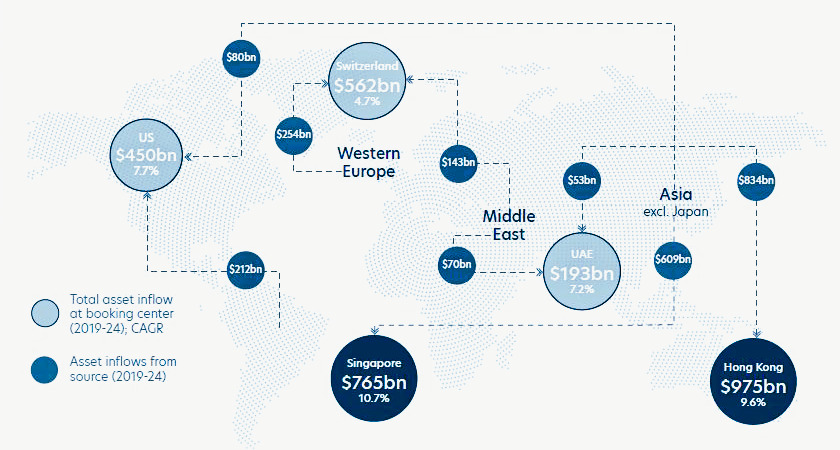
Global wealth patterns are shifting. Reshaping the centre of gravity of the wealth management industry, Asia has become the fastest-growing private wealth market globally. 25 years ago, the region accounted for only 6% of global wealth; today, it represents 21%. This growth trajectory is expected to continue, with Asia on course to hold roughly 1/4 of global private wealth by the end of the decade, hitting $99 trillion by 2029.
Within fast-growing Asia, Southeast Asia (SEA) is seeing similar growth, driven both by rising affluence and demographic change. With over 60% of high-net-worth individuals (HNW) aged above 60, the region stands at a pivotal moment for intergenerational wealth transfer.1 At the same time, increasing financial literacy2,3 and digital adoption are reshaping demand for transparent, technology-enabled wealth solutions.
This article will provide a WealthTech update for the year 2025 in SEA, and an outlook for 2026, and beyond.
WealthTech Ecosystem in Southeast Asia
The WealthTech landscape spans a broad value chain that can be grouped into three main categories: Direct-to-Consumer (D2C), Business-to-Financial Institution (B2FI), and Business-to-Financial Advisor (B2FA), as illustrated in the infographic below.
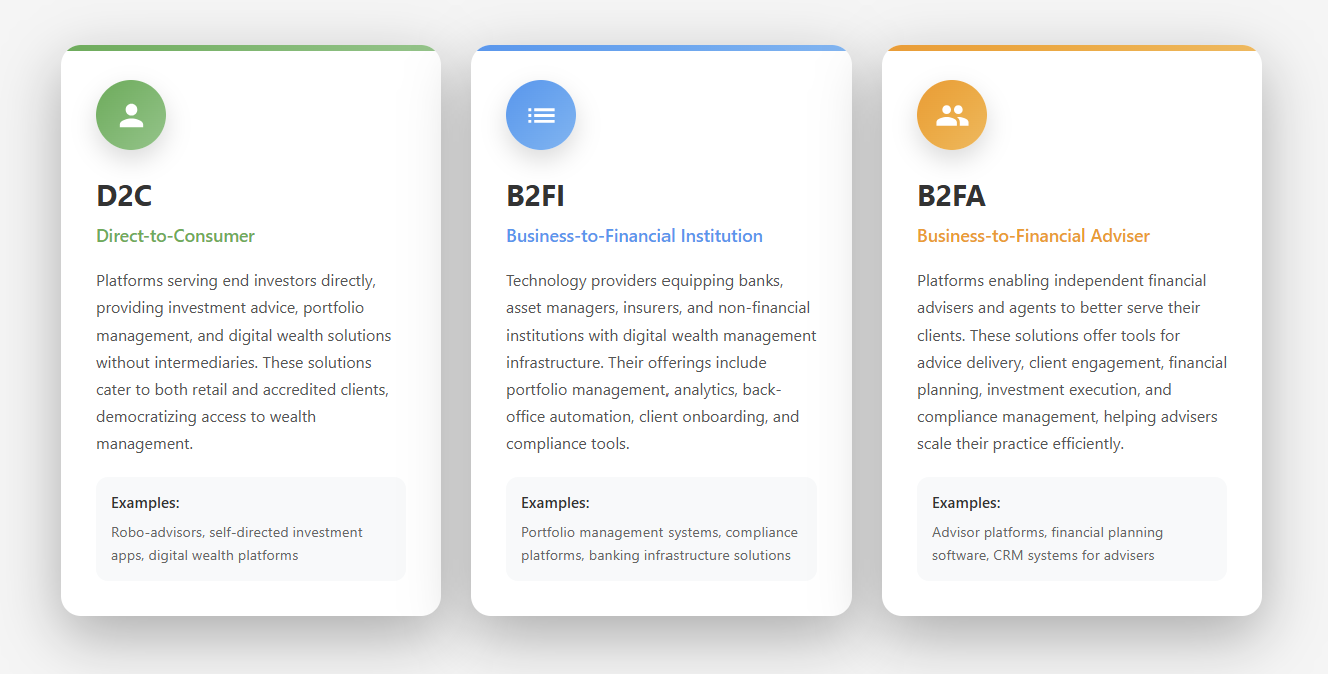
In Southeast Asia, the WealthTech ecosystem is expanding across three closely connected dimensions. On the product side, platforms are broadening investor access to non-traditional asset classes such as private markets, real estate, digital and crypto assets. From a customer perspective, solutions are increasingly tailored to distinct segments, ranging from mass-affluent investors to high-net-worth individuals and family offices. These offerings are delivered through platform-centric models that prioritise simplicity, diversification, scalability, and a seamless digital experience, enabling lower costs and more consistent access to advice.
Beyond traditional equities and bonds, platforms now provide access to private markets that were historically reserved for HNW and UHNW investors, including private equity, private credit, real estate investment trusts (REITs), pre-IPO stocks, and a variety of crypto assets are now accessible in smaller fractions for eligible investors. These WealthTechs are mostly based in Singapore or Hong Kong, where the regulatory environment can accommodate the broadest range of investments. These developed financial centres are also home of the sophisticated client base served by a deep pool of private banks, and wealth and asset managers.
Developed Southeast Asia: Contrasting WealthTech Approaches
Singapore and Hong Kong are the region’s main WealthTech hubs, but with different focuses. Singapore supports around 40 WealthTech firms which benefit from pro-innovation regulation and open banking, mainly on buy-side platforms (i.e. D2C or B2FA) for investing, AI analytics, data aggregation and reporting.
Hong Kong remains more sell-side oriented, centred on product issuance and trading. Both markets saw FinTech funding decline in 2025, highlighting a more cautious investment environment and a focus on sustainable growth.
Developing Southeast Asia
In developing SEA markets, such as the Philippines, Indonesia, and Vietnam, WealthTech growth is driven by rising mass-affluent populations, high mobile adoption, and limited legacy wealth infrastructure. Progress focuses on digital solutions that expand access and inclusion, and is less centred on sophisticated capital markets platforms than Singapore and Hong Kong.

Bank-led platforms and partnerships, like BPI Wealth in the Philippines, demonstrate how digital tools can scale onboarding, portfolio management, and advisory services. BPI maintains assets under management (AUM) of PHP 1.7 trillion, representing a 21% market share5, and is expanding its digital wealth capabilities through a suite of platforms and partnerships that broaden access to advice‑led investing for affluent and emerging investors in the Philippines.
Despite strong potential, growth is constrained by regulatory fragmentation, uneven investor protection, and limited cross-border access. These conditions favour locally-anchored, scalable WealthTech models, and as intergenerational wealth transfer accelerates, developing SEA is likely to become a major growth engine for digitally-enabled, advice-centric solutions.
WealthTech Start-up Funding in Southeast Asia
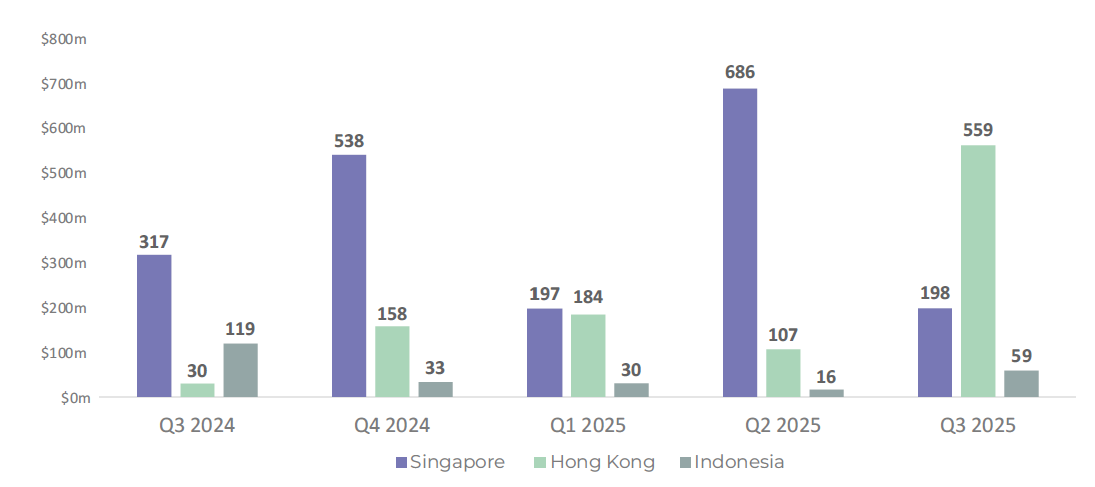
FinTech funding in SEA, particularly Singapore, declined sharply in 2025. Singapore saw a 19% drop in total funding in the first nine months of the year compared to 2024, with Q3 down 38% year-on-year and no deals exceeding $100 million in the recent quarter.7
Globally, WealthTech funding fell 66% in H1 2025 to $4.5 billion. Q3 investments halved to $1.8 billion amid a lack of deals over $100 million8, and full-year funding is projected to decline 46% to $8.9 billion, reflecting a shift from mega-rounds toward smaller, mid-stage investments. SEA mirrored this slowdown, with regional funding down 36% to $835 million and heavily concentrated in late-stage rounds, 87% of which went to Singapore.
Many SEA WealthTech platforms are advancing rapidly, skipping steps seen in more mature and developed markets due to younger demographics and limited legacy infrastructure. While HNW and UHNW clients may retain existing wealth managers, significant shifts are expected as intergenerational wealth transfer accelerates. As Lee Lung-Nien, Asia South Chairman at Citi Private Bank stated, “A $100 trillion inter-generation wealth transfer is occurring, and the next generation often has distinct values and philanthropic priorities.” 9
Regulatory Developments in Southeast Asia
Regulatory frameworks across SEA remain uneven, with gaps in cross-border activity, fee transparency, and investor protection. Despite the 2014 ASEAN Banking Integration Framework (ABIF), progress towards a truly integrated regional banking market remains limited due to weak policy coordination and a lack of common standards. With only a handful of countries and banks actively participating, and as banking shifts from branches to digital channels, ASEAN’s integration strategy clearly needs a reset.10
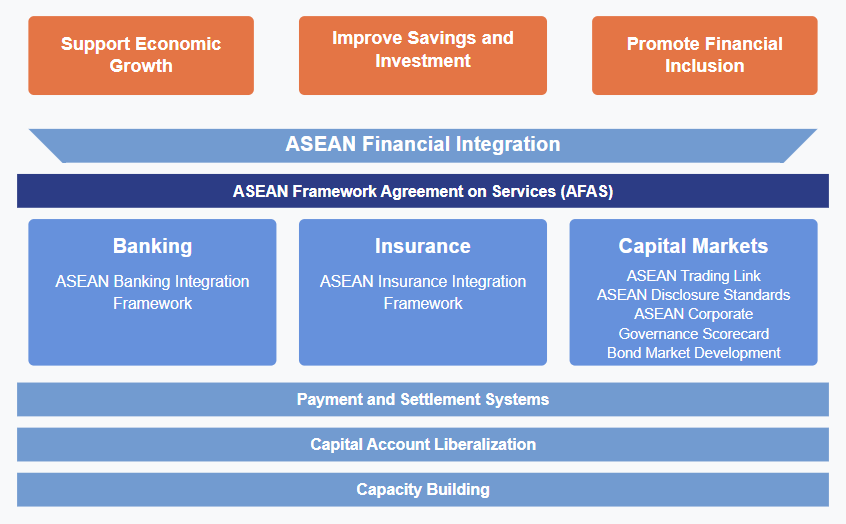
The infographic above, dated from 2016, explains the complexity of a regional financial integration. The goals are to support economic growth, improve savings and investments, and promote financial inclusion, without a top-down centralistic approach considering the multi-cultural and diverse region.
Indonesia and the Philippines are often seen as higher‑risk regulatory environments, where frequent rule changes, fragmented supervision, and weaker rule of law complicate the distribution of both domestic and foreign investment products and can deter foreign intermediaries from offering more competitive cross‑border solutions.
Other countries are considered more regulatory stable. Malaysia benefits from clearer FinTech and digital investment rules, including peer-to-peer lending, equity crowdfunding, and digital investment managers, though cross-border advice remains limited. Meanwhile, Vietnam has advanced broader reforms but still has nascent capital-market rules, constraining access to diversified and high-quality foreign securities.
Throughout the region, Open Banking, Open Finance, and Open Wealth regulations are advancing at different paces. Singapore and Hong Kong lead with comprehensive guidelines and digital/crypto asset frameworks, while Malaysia, Vietnam, and the Philippines are exploring or implementing APIs by 2025. Elsewhere, regulatory approaches remain cautious, using sandboxes, limits, and CBDC pilots to manage risk while allowing controlled innovation.
New Technologies and Business Models
In recent years, Generative AI and large language models (LLMs), followed by agentic AI, have become widely adopted in wealth management. Over 50% of executives view AI as central to scaling operations, according to the 2025 Natixis Wealth Industry Survey.12 Leading firms such as JPMorgan, UBS, and BNP Paribas have deployed GenAI at scale, with private banks including LGT and Pictet close behind.
In SEA, adoption is accelerating among regional leaders and local players. DBS and Bank of Singapore have embedded AI and advanced analytics to improve advisor productivity and client engagement. Bank of Singapore boosted hiring and technology to join Asia’s top five private banks after AUM rose nearly 20% to $145 billion in Q3-202513, with its AI-enabled portfolio workbench on BlackRock’s Aladdin platform delivering measurable productivity gains.14 In developing markets, BPI in the Philippines has deployed BEA Chat, a GenAI-powered assistant for both staff and clients, extending advice-led services to retail and affluent segments.
In this region, digital-native banks and platforms hold structural advantages with large customer bases and mobile-first architectures, while their rapid growth intensifies competitive pressure on incumbents. This drives investment in technology, skills, and partnerships, while collaboration with specialist providers is increasing.
Platforms like Arta AI15 and on-chain platforms such as Enzyme Finance16 demonstrate how AI, blockchain, and analytics automate analysis, reporting, and client engagement, shifting from manual, intermediary-heavy processes to continuous, data-driven operations. These digital platforms are filling the gaps left by less mature capital markets, creating tailored local solutions that emphasize ease of use, lower costs, and mobile-first experiences. As global platforms such as Revolut and Robinhood expand into SEA, competition is intensifying around integrated, open, and scalable wealth-management operating models.17
Advanced data analytics underpin these evolutions, aggregating financial and behavioural data to support goal-based strategies. Banks such as DBS show how embedding these capabilities enables more personalised investment aligned with client goals.18 Emerging technologies such as quantum computing remain nascent but are increasingly on the strategic horizon.19
Growing complexity among high-net-worth families is also driving demand for dedicated family office technology. Succession planning remains underdeveloped across Asia20, creating risks and a need for interoperable platforms that manage multi-asset, multi-jurisdictional portfolios and compliance. This has fostered an expanding ecosystem of family office solutions. As François Botha, a family office technology expert notes, “family offices are no longer experimenting with technology; they are actively searching for the right tools and implementing them.” 21 Dezerv, India’s full-stack WealthTech, exemplifies this trend, combining equity, credit, and family-office services with dedicated relationship managers.22
A potential Target Operating Model for Wealth Management is shown below. It connects client-facing channels (online, mobile, advisors, and service centres) with the core capabilities needed to deliver a seamless client experience, from lifecycle management and advisory to discretionary mandates, estate planning, and execution. These capabilities sit on top of an integration layer that ties into markets, data providers, and group functions, ensuring that operations, risk, compliance, reporting, and revenue models work together in a coherent and scalable framework.

To implement an open-architecture operating model, wealth management firms should invest in stable, high-performance technology architectures and leverage established standard API protocols. Two main approaches have emerged: a vertical, industry-focused model and a horizontal, cross-industry API standards model.
Within the wealth management sector, the Open Wealth API developed by the Open Wealth Association has gained traction, particularly in Singapore, with early implementations orchestrated by Synpulse, a leading Swiss consulting firm.23 Beyond wealth management, OpenAPI is becoming the de facto standard for cross-industry data and feature integration, driven by super-apps and broader digital ecosystems. To reduce IT engineering effort, buy-side investors can also rely on data aggregation and reporting platforms such as Canopy and Altoo, which cover both bankable and non-bankable assets.24
In Thailand, SCB and Julius Baer provide a strong example of successful collaboration between financial service providers, demonstrating how effective cooperation can be achieved between a traditional Swiss private bank and a leading local universal bank.
Outlook for 2026 and beyond
SEA’s wealth management landscape is entering a decisive phase. Rapid wealth creation, intergenerational transfer, rising financial literacy, and deep digital adoption are reshaping how advice, products, and platforms are delivered. Growth is increasingly driven by mass-affluent and emerging HNW segments in developing markets seeking transparent, digital-first, goal-based solutions.
Competition is intensifying, accelerating adoption of integrated platforms that combine human expertise with AI, advanced analytics, and open architecture. Technology augments advisors rather than replacing them, enabling scalable personalisation and broader access. Digital banks, super apps, and specialist platforms are reshaping expectations, while incumbent banks retain advantages in trust, regulatory standing, and local relationships.
In this landscape, digital and foreign players are more likely to succeed through collaboration than outright displacement. The rise of digital universal banks and super apps, exemplified by Revolut’s expanding SEA footprint25, reflects a trend toward consolidated financial ecosystems. China’s private banks further highlight how integrated, platform-based models can redefine next-generation wealth management.26
Structural constraints remain, however, including uneven regulation, fragmented markets, limited cross-border access, and underdeveloped retirement systems. Success depends on flexible models that adapt to regulatory regimes, partnering with technology providers, and integrating new products efficiently. Collaboration between traditional and digital players is likely to define the next growth phase rather than wholesale disruption.
Looking toward 2026 and beyond, firms aligning strategy, technology, and operating models across products, markets, processes, and partnerships will capture the next wave of wealth growth. The region’s WealthTech leaders will be those that move decisively, embrace openness, and build platforms for a broader, younger, and digitally engaged investor base. The message is clear: the pace of change is accelerating, and standing still is no longer an option.
References
- UOB, The Asia Generational Wealth Report 2025, November 2025: https://www.uob.com.sg/assets/web-resources/private/pdfs/our-insights/the-asia-generational-wealth-report/asia-generational-wealth-report-2025.pdf]
- Statista, Wealth Management – Southeast Asia, October 2025: https://www.statista.com/outlook/fmo/wealth-management/southeast-asia
- Redseer, WealthTech: Riding SEA’s $70B Digital Gold Rush, August 2025: https://redseer.com/articles/wealthtech-riding-seas-70b-digital-gold-rush/
- McKinsey, WealthTech in Asia–Pacific: The next frontier in financial innovation, October 2025: https://www.mckinsey.com/industries/financial-services/our-insights/wealthtech-in-asia-pacific-the-next-frontier-in-financial-innovation
- Business World, BPI Wealth targets 20% AUM growth, October 2025: https://www.bworldonline.com/banking-finance/2025/10/03/702605/bpi-wealth-targets-20-aum-growth/
- BPI, Facebook post, December 2024: https://www.facebook.com/bpi/photos/-make-your-money-grow-easily-online-with-bpi-wealth-builder-investing-has-never-/1015430590628298/
- GFTN, Fintech Investments Flash Report Q3 2025, October 2025: https://gftn.co/gftn-insights/fintech-investments-flash-report-q3-2025
- GFTN, Fintech Investments Flash Report Q3 2025, October 2025: https://gftn.co/gftn-insights/fintech-investments-flash-report-q3-2025
- PR Newswire,Citi Private Bank Launches Philanthropy Advisory Solutions in Asia, March 2025: https://www.prnewswire.com/apac/news-releases/citi-private-bank-launches-philanthropy-advisory-solutions-in-asia-302405192.html
- Sakda Sau, ASEAN Banking Integration Framework at a Crossroads, CIL, National University of Singapore, December 2025: https://cil.nus.edu.sg/wp-content/uploads/2025/12/ASEAN-Ideas-in-Progress-01-2025-Sakda-Sau.pdf
- Sakda Sau, ASEAN Banking Integration Framework at a Crossroads, CIL, National University of Singapore, December 2025: ttps://cil.nus.edu.sg/wp-content/uploads/2025/12/ASEAN-Ideas-in-Progress-01-2025-Sakda-Sau.pdf
- Natixis, 2025 Wealth Industry Survey, March 2025: https://www.im.natixis.com/en-latam/insights/investor-sentiment/2025/wealth-industry-survey
- Reuters, on CEO about Bank of Singapore investing in technology, November 2025: https://www.reuters.com/business/finance/bank-singapore-invest-hiring-tech-boost-assets-ceo-says-2025-11-27/
- Financial Times, FT PWM WealthTech Awards, May 2025: https://www.pwmnet.com/content/54e07352-8a95-5283-9a43-37b15743088d
- PR Newswire, Avantgarde, Unleashing the Potential of On-Chain Asset Management, November 2025: https://avantgarde.finance/post/unleashing-the-potential-of-on-chain-asset-management
- Avantgarde, Unleashing the Potential of On-Chain Asset Management, November 2025: https://avantgarde.finance/post/unleashing-the-potential-of-on-chain-asset-management
- The Asian Banker, Revolut Expansion in SEA Wealth Services, March 2025: http://theasianbanker.com/updates-and-articles/revolut-expands-in-singapore-and-southeast-asia-with-wealth-and-multi-currency-services
- CNBC, CEO of DBS at SFF 2025, November 2025: https://www.cnbc.com/2025/11/14/ceo-southeast-asias-top-bank-dbs-says-ai-adoption-already-paying-off.html
- World Economic Forum, Quantum Computing strategies for FS Leaders, July 2025: https://www.weforum.org/publications/quantum-technologies-key-strategies-and-opportunities-for-financial-services-leaders/
- Sun Life, Legacy and Succession Survey, November 2025: https://www.sunlife.com.sg/en/insights/
- Francois Botha, The 2025 Family Office Software Roundup, Forbes, November 2025: https://www.forbes.com/sites/francoisbotha/2025/11/09/the-2025-family-office-software–roundup/
- Fintech Global, Dezerv raises ₹350cr to expand wealth platform, October 2025: https://fintech.global/2025/10/14/dezerv-raises-%e2%82%b9350cr-to-expand-wealth-platform/
- The Asian Banker, Swissquote Singapore Elevates EAM and MFO Connectivity with OpenWealth API Integration, November 2025: https://www.theasianbanker.com/mediafeed-news/details?rkey=20251117AE25780&filter=23792&pd=18%20Nov%202025
- Simple, Altoo vs Canopy, website: https://andsimple.co/compare/altoo-vs-canopy/
- The Asian Banker, Revolut expands in Singapore and Southeast Asia with wealth and multi-currency services, March 2025: http://theasianbanker.com/updates-and-articles/revolut-expands-in-singapore-and-southeast-asia-with-wealth-and-multi-currency-services
- TAB Insights, Chinese private banks launch integrated entrepreneur-oriented services as market and regulatory pressures mount, March 2025: https://reports.tabinsights.com/article/chinese-private-banks-launch-integrated-entrepreneur-oriented-services-as-market-and-regulatory-pressures-mount



Comments are closed.