

Evolving Management Toward AI-powered and Insights-Driven Organizational Transformation
What is the future of management in a world of smart algorithms?
Data, Insights and AI – we are in a new business world and management is evolving too. This article will help you understand the future of management.
We all know that data is great and insights are powerful, but with evolving technologies in algorithms, AI, and especially with the advent of LLMs, we could argue that we are at a pivotal moment in the evolution of business management. The convergence of digital innovation, artificial intelligence and data analytics is fundamentally reshaping how organisations operate, compete and thrive in an increasingly complex business landscape. Overnight, it seems, companies are faced with the imperative to transform themselves into Insights-Driven Organisations (IDOs) – entities that use data, analytics and artificial intelligence to improve decision-making, drive innovation and accelerate growth.
Index
The Dawn of a New Management Era
This sudden and, for many organisations, dramatic change is no longer a strategic ‘option’, it’s a necessity as it becomes clear that many industries need to change dramatically to remain relevant and competitive. I once said, “One thing is certain: a data-driven approach to decision making is no longer a nice-to-have, but a must-have for today’s organisations”. In a nutshell, this means that organisations that successfully make this transition will reap significant benefits: identifying growth opportunities that others can’t see, making faster and more confident decisions, streamlining operations and costs, and delivering superior customer experiences – all while outperforming the competition, being more cost effective, and increasing the chances of generating more revenue.
The rise of generative AI has been particularly interesting in the context of management and consulting. Suddenly we could make use of unstructured data, while at the same time enabling better ‘human-machine communication’. This trend may be as significant as the creation of core strategic frameworks in the 1970s and 80s. While earlier waves of business analytics and ingelligence only improved specific business functions, today’s AI capabilities have the potential to transform almost every aspect of management and strategy, from initial market assessment to knowledge management and, with agentic frameworks, even execution and monitoring.
In this new era, management itself is being reimagined. The skills, processes and organisational structures that defined successful businesses in the past are giving way to new paradigms centred on insights, agility and AI-human collaboration. Leaders must navigate this shifting terrain, balancing technological capabilities with the irreplaceable human elements of judgement, creativity and strategic courage.
The Competitive Advantage of Early Adoption
A new era of management is dawning, and you should understand whyIn every wave of innovation and paradigm shift, there is power in being early to the game. This time will be no different, and the early adopters of AI-driven insights will reap significant benefits:
- They build institutional knowledge and capabilities that are difficult for competitors to replicate
- They attract top talent who want to work with cutting-edge approaches
- They develop proprietary data ecosystems before their value becomes widely recognized
- They have more time to refine their approach through experimentation and learning
The democratisation of insights means that “companies that use generic inputs will produce generic outputs”. Early adopters have the opportunity to define what constitutes valuable, proprietary insights in their industry before standards become commoditised. Literally, the earlier you start to separate the noise from the signal, the better your organisation will be able to use AI and insights as a strategic driver.
The Evolution of Decision-Making
The Critical Distinction: Data-Driven vs. Insights-Driven
Although often used interchangeably, ‘data-driven‘ and ‘insights-driven’ represent fundamentally different approaches to business strategy. I often make a big distinction between data-driven companies, where the collection of data is important for later potential analysis. The best example would be Google, which is a company that collects huge amounts of all kinds of data without knowing what to do with it – and then later provides the opportunity to make connections or derive insights from that data. This is a costly and very comprehensive strategy that is out of reach for most organisations.
The insight-driven organisation (IDO), on the other hand, focuses on interpreting the data and extracting actionable intelligence from it – just as you would read a book (the data), but in the end the core idea stays with you, even if you do not remember every word of the book. The focus shifts from the data itself to its meaning – the ‘why’ behind the numbers and patterns. Such insights can be generated internally, but they can also be drawn from external sources such as studies, industry best practice or what we call ‘experience’. This distinction is critical: while data is the records and pieces of information behind what’s happening, insights reveal the reason and condensed knowledge of why it’s happening and what to do about it, and so the insights-driven organisation focuses more on working with insights, gathering the important pieces and making fact-based decisions, which are becoming more accessible with more advanced algorithms and AI.
This evolution reflects a broader maturation in management practices that can be understood through four distinct horizons:
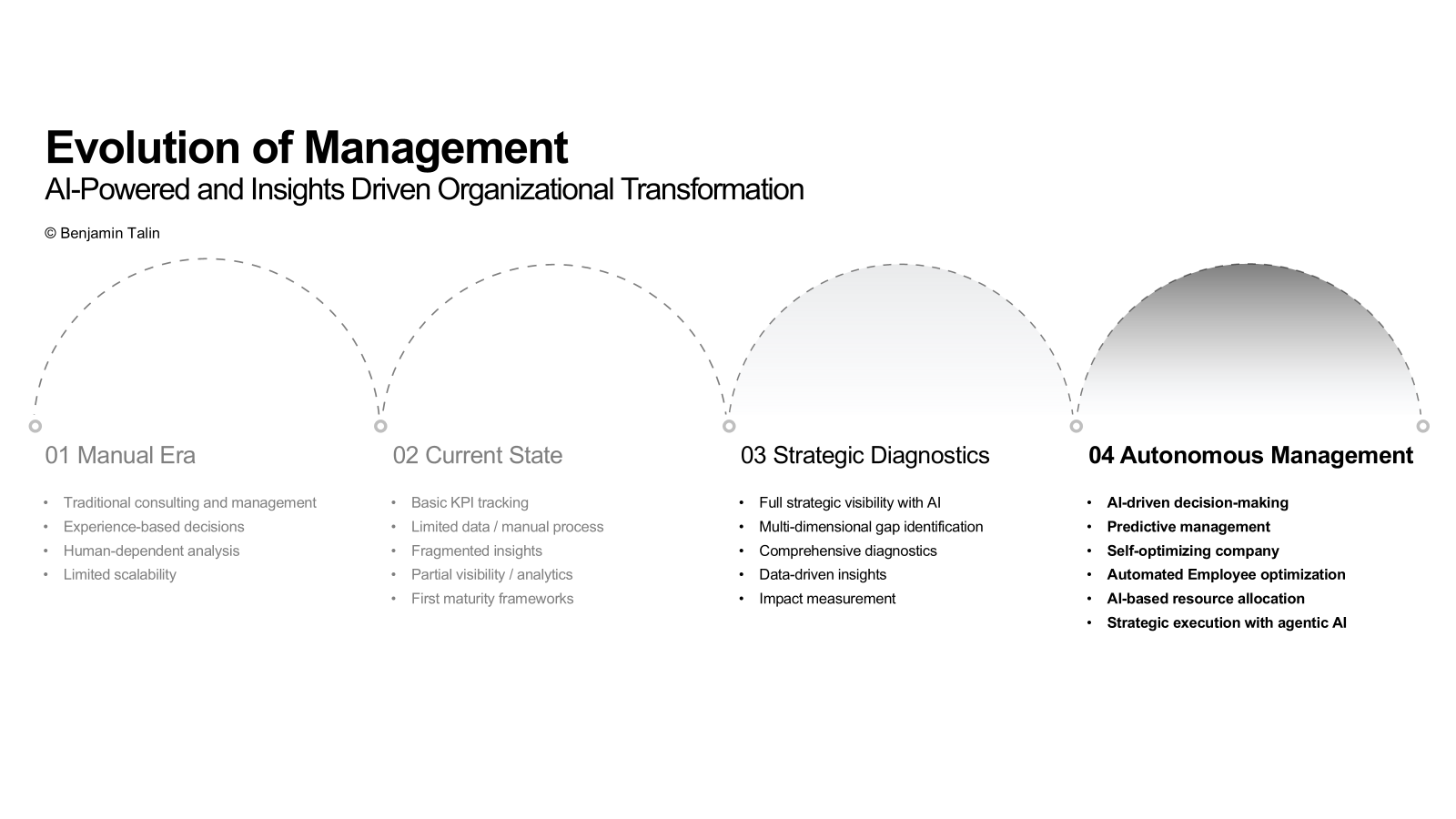
Horizon 01: The Manual Era (till 2000s)
The starting point for most organisations has historically been what I call the traditional or ‘manual era’ of management. Most techniques are based on either individual experience or the management theories of the 1970s and 80s. Some of the key characteristics are:
- Traditional consulting and management approaches
- Experience-based and intuition-driven decisions
- Human-dependent analysis with significant subjective elements
- Limited scalability as analysis remains largely manual
- Siloed information with minimal cross-functional visibility
In this early period of management, organisations relied heavily on the accumulated wisdom of senior leaders (internal executives or external consultants), whose experience-based judgement served as the primary decision-making mechanism. While this approach has its merits – particularly the deep domain knowledge that such leaders often possess – it struggles to cope with the complexity, speed and volume of data in today’s business environment.
Horizon 02: The Current State – Early Data Adoption (2000-2020)
Many organisations today operate in what might be called an early data adoption phase. Computers are in use, data is available and being tracked in Excel and other systems such as ERP. This is characterised by:
- Basic KPI tracking and performance metrics
- Limited data collection with largely manual processes
- Fragmented visibility across departments and functions
- Partial visibility through preliminary analytics capabilities
- First generation of digital management frameworks in place
- Dashboards and reports mostly used
Today, most organisations recognise the value of data, but haven’t fully integrated it into their management approach. They collect some information and monitor key metrics, but the infrastructure, processes and culture to turn this data into comprehensive insights remain underdeveloped. Decisions may incorporate data points, but often in an ad hoc way that fails to capture the full picture.
While this is a step forward from pure intuition-based management, it has significant limitations.
Horizon 03: Strategic Diagnostics – The Emergence of True IDOs (2020+)
The third horizon, which explains the current shift, is the emergence of true insights-driven organisations, where data analytics and AI converge to enable much more than simple dashboards for input. The emergence of more comprehensive frameworks, and better and more consistent data capture, enables the use of more advanced AI and analytics. The current shift is towards these features:
- Full strategic visibility across the entire organization
- Multi-dimensional gap identification and opportunity analysis
- Comprehensive diagnostics integrating multiple data sources
- Truly data-driven insights informing all key decisions
- Advanced impact measurement and continuous feedback loops
In the coming years, in this third horizon of management, organisations will move beyond simply collecting data to systematically transforming it into insights that drive strategic action. AI plays a critical role here, serving as researcher, interpreter, thought partner, simulator and communicator. The insights generated are no longer isolated data points, but integrated perspectives across departments and data silos as advanced AI becomes better at understanding unstructured data. This will illuminate complex business challenges from multiple angles, enabling much better decision making and even continuous improvement loops.
This is the stage where the competitive advantages of being an IDO become most apparent. Organisations operating on this horizon make faster, more accurate decisions, identify emerging opportunities before competitors do, and allocate resources more effectively based on predictive insights rather than historical patterns.
Horizon 04: Autonomous Management – The Future State (2030+)
If we extrapolate current trends towards the Insights Driven Organisation (IDO), we will find a new opportunity. Imagine intelligent systems that automatically identify challenges and then optimise businesses accordingly. This final horizon represents the frontier of management evolution – a future state enabled by AI and advanced analytics:
- Automated decision-making for routine and complex situations
- Self-optimizing operations that continuously improve performance
- Predictive management identifying issues before they arise
- Consulting automation that democratizes strategic expertise
- Automated employee upskilling aligned with emerging needs
- AI-augmented strategic execution with real-time adjustments
While many elements of this futuristic scenario remain on the aspirational side, it is true that emerging technologies are bringing it increasingly within reach. In this potential future state, AI doesn’t replace management, it fundamentally transforms it. Human leaders focus on setting direction, making value judgments and maintaining the human elements of the business, while AI systems handle execution optimisation, pattern recognition and predictive forecasting.
It is important to note that the evolution across these horizons is more than a technological advance. It reflects a fundamental shift in management philosophy and how leading companies are formed, from experience-based intuition (hiring the best talent) to evidence-based insight (using facts the right way). And each horizon will create its own leaders and new entrants. Just think about how many startups are making over 100 million in revenue with less than 100 employees … something that was not possible before. And that will widen the gap between the leaders and the laggards.
AI’s Transformative Role in Strategy and Management
But let’s focus a little bit on strategy and how artificial intelligence is not just enhancing traditional management approaches and transforming white-collar workers in particular. It’s now possible for alorithms and systems to fundamentally change the way strategy is developed, decisions are made and organisations operate. The impact of the abundance of data and the emergence of AI in strategy development represents a new inflection point – an opportunity for entirely new strategies, away from the old style “I’ve experienced it before” to a more focused version of “there’s the data to prove it”. But to understand it better, we also need to understand its impact on various strategic elements, from understanding to interpreting, brainstorming, testing, communicating and, most importantly, optimising. BUT – and this is a big BUT – AI is obviously not perfect and data can also be ‘biased’ and just plain wrong. So for any role, make sure you take advantage of the software, but don’t try to fall for the fallacy that it’s omniscient. It is a tool and you still need to understand what it does and how it can help you – it does not replace human logic.
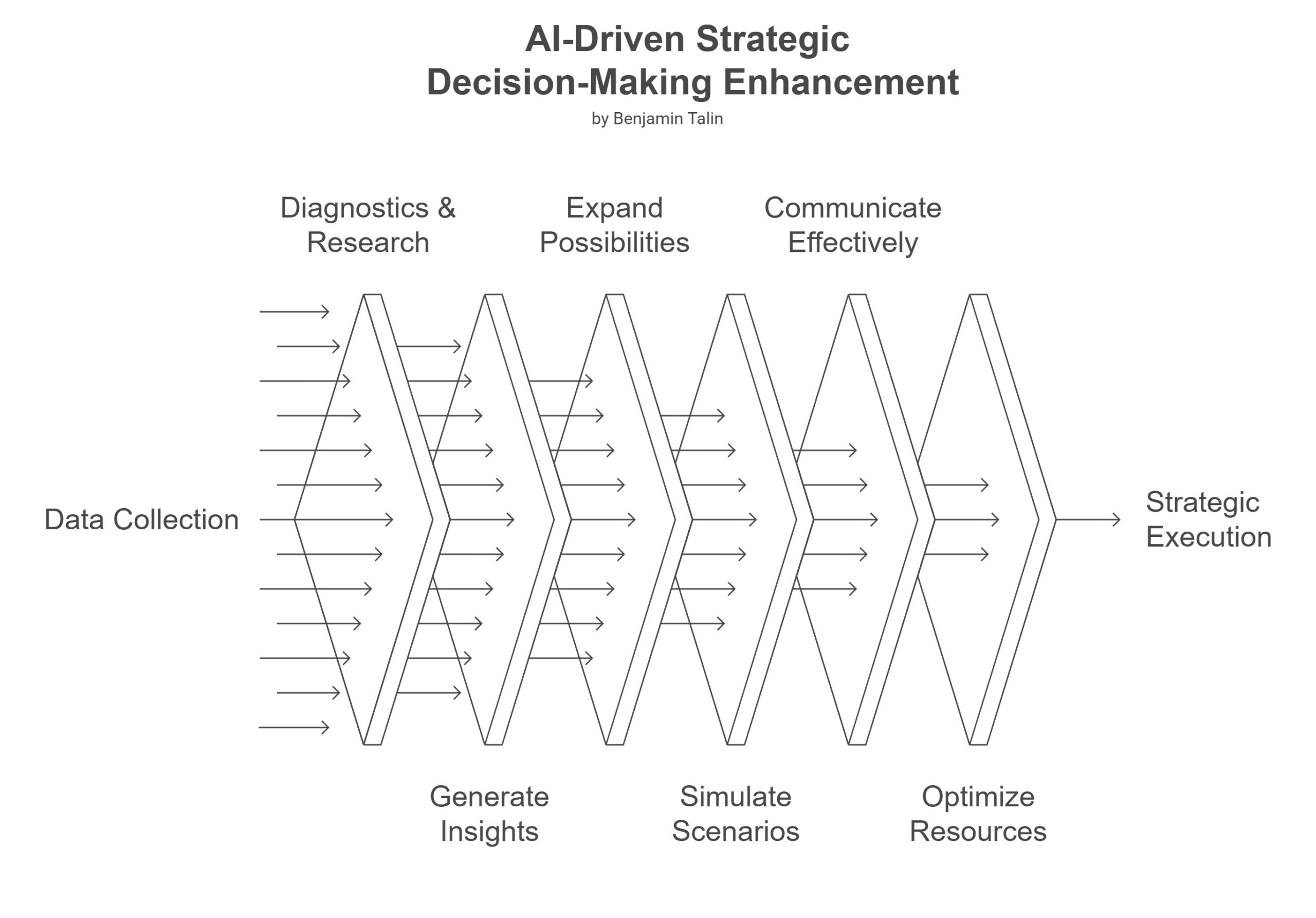
The 6 Key Roles of AI in Strategy Development
1. AI as Researcher
Goal: Accelerate information discovery and synthesis of large amounts of data
Strategists typically spend a great deal of time gathering and analysing information from disparate sources. AI dramatically accelerates this process, not just by compiling data, but by identifying meaningful connections between disparate data sets.
Consider M&A target identification: Traditional approaches rely heavily on executives’ market knowledge and intermediary networks – often resulting in a serendipitous and limited search process. AI-powered tools can systematically scan information on millions of companies across languages and geographies, identifying under-the-radar opportunities that align with strategic goals in minutes rather than months. But AI’s research capabilities go beyond raw efficiency. These tools can identify non-obvious correlations and patterns that human analysts might miss, uncovering hidden opportunities and threats. The key takeaway here is that while AI excels at comprehensive and unbiased research, human strategists remain essential in asking the right questions and determining which insights really matter.
2. AI as Interpreter
Goal: Transforming Data into Meaningful Insights
Raw data, no matter how comprehensive, is of limited value without proper interpretation. AI’s growing interpretive capabilities bridge the gap between data collection and strategic action.
For example, organisations seeking growth can use AI to create ‘growth scans’ that analyse competitive moves, customer needs and market dynamics to identify promising adjacencies. These systems don’t just list opportunities, they assess their strategic fit, providing strategists with a filtered set of options enriched with historical precedent and benchmarking data.
Similarly, AI’s interpretive capabilities are revolutionising trend monitoring. Rather than simply tracking metrics, advanced systems can break down complex trends into component patterns and determine whether a trend is accelerating, maturing or waning long before these shifts become apparent in traditional metrics. For example, an organisation interested in sustainable building materials can monitor architect interest, patent volumes and competitor mentions to anticipate shifts in demand long before they affect sales figures.
3. AI as Brainstorming Partner
Goal: Challenging inputs and adding context to expand possibilities
Perhaps the most profound change comes from AI’s emerging role as a strategic thinking partner – challenging assumptions, countering biases and expanding the range of possibilities organisations consider. In brainstorming sessions, AI can suggest unconventional approaches from different industries and contexts, helping teams avoid the pull of established mental models. More importantly, AI can systematically pressure test strategic plans against established frameworks, identifying potential blind spots and hidden risks that might otherwise go unnoticed.
This ability is particularly valuable in combating confirmation bias – the human tendency to seek out information that confirms existing beliefs while dismissing contradictory evidence. By acting as an objective challenger, AI helps ensure that strategies are based on comprehensive analysis rather than selective interpretation.
4. AI as Simulator
Goal: Modelling complex scenarios and finding favourable outcomes
Strategic decisions inevitably involve uncertainty. Before committing to a course of action, leaders must consider how different scenarios might unfold based on market conditions, competitor responses and external factors.
AI transforms scenario planning from an abstract exercise into a rigorous analytical process. Advanced modelling capabilities allow organisations to simulate complex market dynamics, test different strategic approaches and quantify potential outcomes with unprecedented accuracy. This capability extends beyond initial planning to continuous monitoring during execution, with AI systems analysing early market signals and alerting teams when adjustments may be required.
The example of the Southeast Asian bank in the McKinsey article illustrates this perfectly: AI helped the organisation simulate P&L and growth projections for different strategic options, using internal data from previous expansions to realistically assess execution capabilities. This combination of forward-looking projection and historical learning creates a powerful feedback loop that improves strategic decision-making.
5. AI as Communicator
Goal: Easily Communicating Strategic Narratives for Maximum Impact
Even the most brilliant strategy only creates value if it is effectively communicated and implemented. AI’s natural language capabilities are revolutionising the way strategic narratives are created and shared across organisations. Generative AI tools can adapt strategic communications for different audiences – from board presentations to frontline implementation guides – ensuring that each stakeholder receives information in the most relevant format and level of detail. This capability extends to monitoring external communications across channels, ensuring consistency in how the strategy is presented to customers, investors and other external stakeholders. Beyond format and consistency, AI can also help evaluate the effectiveness of strategic communications, identifying which messages resonate with different audiences and suggesting refinements to increase understanding and buy-in.
6. AI as Resource Optimizer
Goal: Finding the best allocation of resources
In addition to the five more abstract roles we have already identified, AI serves a critical sixth function in insight-driven organisations: the intelligent optimisation of resources and processes through automated decision systems. This is especially true for strategy, since allocating resources for the greatest impact is the key objective of any good strategy. This role goes beyond simulating potential outcomes to actively recommending or even implementing resource allocation decisions and process improvements.
As a resource optimizer, AI can:
- Flexibility in Strategies: AI can help free up management time to focus on larger strategic issues, while minimising basic day-to-day tasks.
- Automated Decision Systems: Automate routine operational decisions based on pre-defined strategic parameters, freeing human decision-makers to focus on complex strategic decisions
- Strategic Resource Allocation: Continuously monitor resource utilisation across the organisation and automatically reallocate resources (budget, people, computing power, inventory) based on real-time needs and strategic priorities.
- Strategic Workforce Planning: Optimise staffing levels, skill mix and team composition based on project needs, employee skills and strategic objectives
- Strategic Energy and Sustainability Management: Monitor and adjust resource use to minimise environmental impact while maintaining operational effectiveness
This sixth role is particularly powerful because it bridges the gap between insights, strategy and execution. While other AI roles focus primarily on generating insights or facilitating communication, the resource optimiser actively translates insights into operational improvements and efficiencies.
As organisations mature in their AI capabilities, the resource optimiser role will increasingly enable ‘closed-loop’ systems where insights automatically trigger actions that generate new data, leading to refined insights in a continuous improvement cycle.
What happens to the “Human”?
As AI takes over these roles, many may already be hearing “AI will replace our jobs”. Well, it’s not that simple – it’s just going to change, as it always has in recent years. Let’s be clear: the work of human strategists will not be diminished, it will be transformed. Strategic professionals are shifting their focus from information gathering and basic analysis to higher value activities:
- “Out of the Box”-Thinking and Creative Strategies
- Asking the right questions that guide AI research
- Developing hypotheses that AI can test and refine
- Creating unique frameworks that leverage AI insights
- Making judgment calls on values and tradeoffs that AI can inform but not decide
- Building the organizational capabilities and culture needed to execute the strategy
This evolution elevates the strategic function from primarily analytical to increasingly creative and integrative. As routine analytical tasks are automated, strategists can devote more time to those aspects of strategy that require uniquely human skills: creativity, ethical judgement, emotional intelligence, and the courage to make bold commitments in the face of uncertainty.
Conclusion
Let me summarize it in one sentence: There is an Inevitable Shift Toward AI-Powered Insights-Driven Management.
The transformation to an insights-driven organisation, powered by AI, is not just a technology trend, but a fundamental evolution in the way businesses operate and compete, and each technology brings with it new challenges and changing roles, and this time it’s big for management and white-collar work too. In an article I once wrote, I said that “a data-driven approach to decision making is not just a nice-to-have, but a must-have for organisations today”. Organisations that resist this shift risk falling behind competitors who are using AI to make faster, more accurate decisions. And the pace of this change may not always be fast, but as always, the early movers (doing the right thing) will outpace the others. It is not important to be the first, but to be in the early group, because knowledge is accumulated and the earlier you start, the better the learning and reaping of benefits will be.
Let me also add that this transformation is happening across all industries, from financial services to manufacturing, from retail to healthcare. The question is no longer whether to become an insight-driven organisation, but how quickly and effectively you can make the transition.



Comments are closed.