

The Wealth Advisor: Pivotal for Growth in Wealth Management
A Transformation through Coaching
This white paper argues that Advisor Effectiveness Coaching (AEC) is a practical way to transition from product-push sales toward genuinely client-centric advice. Based on the GROW coaching model, it describes a structured programme spanning preparation, a senior-level kick-off, ongoing 1:1 and team coaching, and a “living phase” to sustain momentum. Team leaders serve as the key lever, acting as both coachee and coach to cascade change across the advisory organisation, while AI frees advisors for higher-value conversations. The paper concludes with a phased call to action – pilot, measure, and scale – with the goal of transforming advisors into trusted, augmented wealth partners.
Urs Bolt, Wealth Transformation Catalyst; Jonathan Engalla, Leadership Coach
Wealth management is at a turning point globally, and Southeast Asia is one of the clearest testbeds for what effective advice means. Rapid wealth creation, complex cross‑border situations and a rising mass‑affluent segment are colliding with legacy, product‑centric private‑bank models in markets like Singapore, Hong Kong and across ASEAN, often resulting in fragmented, product‑driven conversations instead of holistic, life‑centred guidance. The main reason to improve and transform the advisor’s role, quality, and advice is therefore the customer: Individuals and families need advisors who understand their values and goals, navigate complexity across generations and jurisdictions, and orchestrate the right mix of digital tools and human insight around them. Advisory force effectiveness programmes, built on coaching, better KPIs and a culture of change, offer a practical way to move from product‑push sales to genuinely client‑centric wealth advice creating long‑term value for customers first, and consequently for the institution.
At the same time, digital transformation, generative AI and emerging agentic AI capabilities have intensified pressure on wealth managers, prompting questions about whether technology will eventually remove the human from the equation. In reality, AI is more likely to reshape than replace the advisor’s role: It can handle scale, data and routine, but cannot replicate the trust, judgment, emotional intelligence and ability to navigate family dynamics and ambiguity that clients count on – especially when it comes to financial wellbeing. Far from eliminating the need for human intervention, the rise of AI makes upgraded human advice more important, not less. Advisory force effectiveness programmes with coaching and richer KPI systems offer a practical way to operationalise this hybrid model in day-to-day practice.
Index
1. Goals – Design a successful, client‑centric Wealth Manager
In a client-centric model, the wealth manager’s goal is to build long-term, trust-based relationships creating and growing sustainable value for both client and bank. This means shifting from product-push to advice-led engagement, redefining success from “how many products sold?” to “how well did we help clients make better decisions across their full balance sheet and life events?” The franchise must be anchored around holistic advice – wealth transfer, business succession, philanthropy, cross-border issues, and family governance – positioning the wealth manager as a trusted counselor through life’s most significant financial transitions and decisions.
This requires balancing financial and non-financial KPIs. Financial metrics – net new assets, revenue per advisor, performance, share-of-wallet, and profitability – measure economic performance. Non-financial indicators assess long-term health: client satisfaction, next-generation retention, advice quality, compliance discipline, and employee engagement. Together, these ensure sustainable value creation.
AI, machine learning, and automation will handle information gathering, documentation, and simple recommendations, freeing advisors for high-value human interactions – deep conversations, complex structuring, and emotional support during volatile markets. Advisors mobilise experts to bring together focused teams to address today’s complex needs of high net-worth private clients. This requires developing “augmented” advisors who are strong in soft skills – empathy, listening, ambiguity navigation, family dynamics – and technical knowledge, able to orchestrate AI tools and specialists while remaining the client’s trusted human decision partner.
In short, the goal is to build an advisory organisation that can deliver superior, human‑centred value in a world where machines handle more of the repeatable work.
2. Reality – The Current State of Wealth Advice
The reality is that, based on annual reports, investor presentations, and personal experience, many wealth managers and private banks in Southeast Asia remain far from that aspiration.
Product-push remains dominant. Incentives and campaigns are often geared around short-term product sales – structured products, funds, insurance, lending – rather than long-term outcomes. Many advisors still measure success by “tickets done” or “AuM booked” rather than relationship depth or client progress toward mutually agreed goals.
KPI systems are heavily financial and backward-looking. Net new assets, revenue, and profitability are typically the primary or only metrics that matter for employee performance management and promotions. Leading indicators such as quality of client dialogues, planning penetration, referrals, and cross-generational engagement are under-measured or ignored.
Cultural and capability fragmentation persists. Integrations of business units, legacy acquisitions, and different market histories create highly inconsistent advisor capabilities and behaviors under one brand. Some desks operate in a sophisticated, advisory-led way; others remain transactional and quota-driven, leading to divergent client experiences, internal tensions, and brand deterioration.
Complexity of client needs outpaces advisor development. Wealth transfer, shifting worldviews between generations, multi-jurisdictional families, value-based preferences, and entrepreneurial liquidity events create a complexity curve for which many advisors are not fully equipped to handle. Advisors are often strong in products or local markets, but less confident navigating ambiguity, family conflict, cross-border constraints, or non-linear life choices.
Digital and AI transformation outpaces human transformation. Banks launch digital platforms, robo-advice, AI pilots, and automation, but the advisor population is not “upgraded” at the same speed. Without a deliberate people-development strategy, digital becomes another channel for product push rather than a lever for deeper advisory conversations.
Predominantly rational, top-down change attempts fall short. Many “transformations” rely on rational levers: new org charts, new KPIs, new systems, new training curricula. They underinvest in mindset, identity, emotions, and behavioral habits, so old patterns reassert themselves once programs end.
Such projects result in a wealth business that talks about “client-centricity” and “advice-led” – however still behaves, measures, and rewards like a sales-driven product factory.
3. Options – How to Change the Culture in Wealth Management
Transforming advisor capabilities and culture can be pursued through different approaches, ranging from directive to non-directive interventions.
3.1 Directive, Top-Down Options
These are common, sometimes necessary, but rarely sufficient on their own:
Top-down orders and policy changes – changing product governance, suitability rules, approval processes, and incentive structures; mandating planning processes or minimum advisory standards.
Traditional training and classroom learning – technical training (products, tax, markets), regulations, and advisory frameworks delivered in workshops or e-learning. Whilst important for foundational knowledge and compliance, they tend to deliver limited impact on actual daily behavior, if not constantly reinforced.
Digital transformation programs – rolling out CRMs, advisory tools, portfolio analytics, remote-advice platforms, and AI assistants. Automation via robotic process automation (RPA) and machine learning (ML) for screening, onboarding, documentation, and portfolio rebalancing. Agentic AI promises to handle more complex workflows over time.
Sales training (not coaching) – short-term initiatives focused on techniques and methodologies, often event-based and decoupled from day-to-day management.
These tools can reset the system “rules,” but they don’t necessarily change what advisors believe, value, and do when nobody is watching.
3.2 Mixed Approaches – More Participative but Still Structured
Practical workshops and simulations – role-plays on client conversations, family meetings, crisis calls; case-based work on generational transfer, cross-border challenges, or value conflicts between family members.
Certification and accreditation – formal certification raising minimum professional standards and signaling commitment to advice quality, combined with internal “badging” for skills such as planning, family governance, or sustainability.
Manager-as-leader programs – training line managers in situational leadership, feedback, and basic coaching tools. Better than pure command-and-control, but often still limited to sporadic application.
These approaches engage advisors more actively, but often still position them as recipients of change rather than co-owners.
3.3 Non-Directive, Developmental Approaches – Where Coaching Enters
A holistic approach to address advisor effectiveness through coaching.
Systemic coaching for advisors and managers – regular 1:1 coaching that uses questioning, reflection, and co-created action plans rather than instructions. Team coaching and supervision focused on learning from real cases, sharing best practice, and aligning behaviors with strategy.
Culture of ownership and self-directed development – Advisors develop options and define their own goals within a clear strategic frame, and own their commitments. Coaching emphasizes intrinsic motivation, identity (“who I want to be as an advisor”), and consistent behavioral shifts.
This identity shift deserves more space. The transformation isn’t just behavioral, it’s about advisors moving from one self-concept to another: from product seller to trusted advisor, from quota-driven to client outcome-driven, from avoiding difficult conversations to leading with clarity through them. Naming these shifts explicitly gives the coaching programme a clear ‘north star’ at the human level, not just the process level.
Integrated into performance management and enablement – coaching is not a side-activity; it is integrated into the advisor’s 1:1s, pipeline reviews, business planning, and capability assessments. Leaders at all hierarchy levels are coached on how to coach (cascade model); they model the new culture.
Compared with directive measures, coaching works at the level of beliefs, habits, and identity – the levers that truly shift culture over time.
4. Way forward – Designing an Advisor Effectiveness Coaching (AEC) Programme
Implementation means designing a practical, scalable advisor effectiveness initiative with coaching as the backbone of advisory transformation.
4.1 What is an AEC programme?
An AEC programme is a structured, multi‑month coaching‑centred initiative that aims to:
- Improve commercial effectiveness (growth, share‑of‑wallet, quality of pipeline and client book).
- Upgrade human capabilities (advisory skills, empathy, ambiguity‑handling, collaboration).
- Align behaviours with a client‑centric, advice‑led strategy.
- Create a self‑reinforcing culture of accountability and continuous improvement.
Coaching is not a replacement for leadership, training or incentives; it is the complementary method that ensures individuals internalise the strategy and take ownership.
4.2 Coaching models – GROW‑ME
Various coaching models have been developed to improve sales and advisory performance, each with different strengths. The OSKAR model focuses on solution-oriented questions and small steps forward. The FUEL model (Frame, Understand, Explore, Lay out) emphasizes framing conversations and exploring options systematically. The CLEAR model (Contracting, Listening, Exploring, Action, Review) prioritizes active listening and structured review cycles. The PRACTICE model offers a comprehensive seven-step framework covering problem identification through evaluation.
While each has merit, the GROW-ME model (Goal, Reality, Options, Way Forward – Monitoring and Evaluation) stands out as a simple and effective approach. Its straightforward structure – defining goals, assessing current reality, exploring options, committing to action, and building in accountability through monitoring and evaluation – makes it accessible for both experienced coaches and line managers learning to coach, while remaining robust enough to drive meaningful behavioral change in wealth advisory contexts.
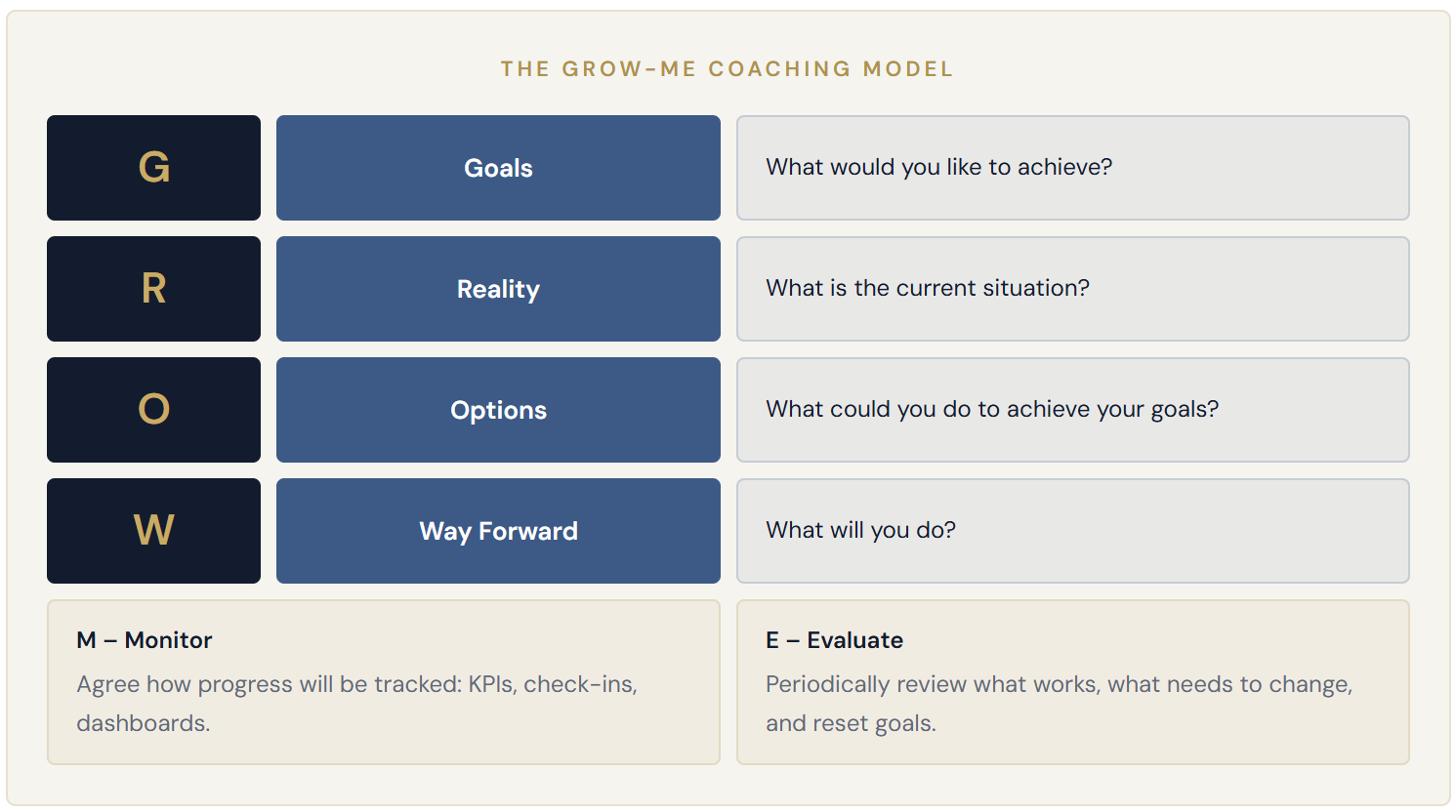
- G – Goals: clarify what the advisor wants to achieve (e.g. deepen 20 core relationships; increase planning penetration; improve client experience scores).
- R – Reality: explore the current state honestly (pipeline quality, meeting habits, book structure, emotional barriers, time‑use patterns).
- O – Options: generate possible routes (behaviour changes, new routines, client‑segmentation choices, different conversation strategies).
- W – Way forward: define specific actions and commitments.
The GROW structure was used to write this article, my discerning readers certainly noticed.
In addition – equally important as the GROW’s steps – are “M” (Monitor) and “E” (Evaluate):
- M – Monitor: agree how progress will be tracked (KPIs, check‑ins, dashboards).
- E – Evaluate: periodically review what works, what needs to change, and reset goals.
This model works equally well at individual, team, and organisational levels, as the key lever is the line manager in the dual role of coachee and coach.
4.3 Topics covered in an AEC Programme
AEC translates strategy into very concrete advisor‑level topics, for example:
- Prospecting and business development
- Lead generation: building and working centres of influence, events, partnerships.
- Getting referrals: systematic asking, follow‑up, referral experience design.
- Prospect conversion: structuring first meetings, discovery techniques, handling objections, articulating value.
- Pipeline and client book management
- Analysing the client book: segmentation, profitability, risk and potential.
- Prioritising clients: who should get more time and in what format.
- Setting ambitions: NNA, revenue per client, share‑of‑wallet, planning penetration.
- Pipeline hygiene: realistic staging, next actions, time to close.
- Client experience and relationship depth
- Apply best‑practice journeys for key client archetypes (e.g. first‑generation entrepreneur vs. multi‑gen family).
- Handling difficult conversations (market drawdowns, family disputes, underperformance).
- Bringing empathy and structure to discussions about values, purpose, and family governance.
- Best Practices and Tactical Topics, e.g. working with AI and digital tools
- Using AI for preparation, scenario analysis, and administrative tasks to free time.
- Positioning AI outputs in client dialogue as support, not as replacement of the advisor’s judgment.
- Reflecting on how technology affects the advisor role and identity.
- A useful coaching principle: data informs, but dialogue transforms. AI delivers the portfolio analytics, risk scores, and meeting prep. The advisor’s irreplaceable job is turning that data into meaningful conversations about family dynamics, values, and life transitions. Coaching advisors to shift from reporting data to facilitating dialogue is a topic in itself.
4.4 Core Elements of an AEC Programme
A robust Advisor Effectiveness Coaching programme typically consists of four phases, as illustrated in the timeline and described below.
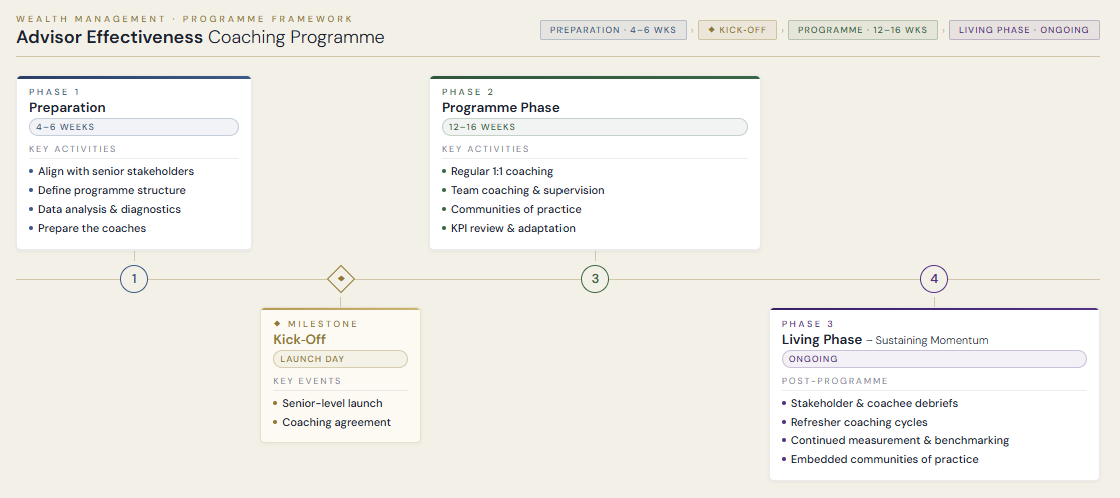
4.4.1 Preparation phase
- Align on goals with senior stakeholders
- Clarify strategic intent: growth, culture change, client‑centricity, risk, or all of the above.
- Agree on target segments (e.g. certain markets, teams, seniority levels).
- Define programme structure
- Scope (duration, number of coaching sessions, team workshops).
- Governance (steering committee, sponsors, reporting lines).
- Coaching topics and KPIs, aligned with business strategy.
- Analyse data and conduct diagnostics
- Baseline KPIs: NNA, revenue, RoA, book structure, client‑interaction metrics.
- Qualitative diagnostics: management interviews, advisor surveys, client feedback.
- Consider adding a behavioral assessment tool (such as DISC) as a baseline diagnostic. Profiling advisor communication styles, motivators, and stress responses during preparation allows coaches to personalize their approach from Day 1 rather than spending weeks reading each coachee. It also gives teams a shared language for how they communicate and collaborate.
- Consider suggesting that AEC programmes include a culture baseline measurement alongside financial KPIs, something like a culture impact scorecard that tracks trust, psychological safety, coaching conversation quality, advisor confidence in difficult conversations, and alignment between stated values and daily behavior. This gives stakeholders something tangible to track beyond revenue and positions culture as a business driver.
- Prepare the coaches
- Train or select internal / external coaches who understand wealth management.
- Run a “coach‑the‑coaches” process to ensure shared standards and approach.
4.4.2 Kick‑off
- Senior‑level launch
- The executive sponsor sets the tone: why AEC matters, how it links to strategy, what success looks like.
- Townhall or leadership meeting to position coaching as high‑status, not remedial.
- Agreeing on the coaching relationship with coachees
- Clarify expectations, confidentiality boundaries, roles and responsibilities.
- Emphasise that coaching is developmental and coachees own their goals and actions.
4.4.3 Programme phase
- Regular 1:1 coaching
- Weekly or fortnightly, time‑bound, in a non‑disturbed setting (on‑site or virtual).
- Strong questioning, active listening, SMART goal‑setting, small steps rather than overwhelming transformations.
- Team coaching / supervision, e.g. in sales meetings
- Weekly or fortnightly sessions where teams share achievements, cases, challenges and best practices.
- Helps align behaviours, not just individual performance.
- Exchange meetings and communities of practice
- Monthly departmental, cross‑desk or cross‑market sessions to learn from top performers, share AI use cases, refine client‑journey practices.
- KPI review and adaptation
- Regular review of progress versus baseline.
- Adjust goals and tactics as learning accumulates.
4.4.4 Living phase – Sustaining Momentum
Sustaining coaching impact requires deliberate effort beyond the initial programme. Structured debriefs with stakeholders and coachees help review outcomes, lessons, and define next steps. Organisations should celebrate successes, share stories, and make role models visible. Follow-up activities may include refresher coaching cycles, ongoing quality management, shadowing or supervision, continued measurement, and benchmarking across business units.
Consider introducing a cyclical model to illustrate how culture sustains itself. A culture flywheel (Clarity, Safety, Trust, Connection, Accountability, Results, Reflection, and back to Clarity) illustrates that culture is not a destination but a continuous loop. Without a visible and repeatable cycle, even the best coaching programmes risk losing momentum once the coach leaves the room.
The “living phase” is often the hardest and most neglected stage. To sustain progress, organisations should establish embedded practices such as peer-coaching triads, monthly case clinics, and shared reflection rituals. Clear ownership is essential to maintain momentum and ensure the coaching culture continues beyond the initial programme.
4.5 Roles in an Advisor Coaching Programme
Key roles in an advisor effectiveness coaching programme. The primary coach delivers the coaching programme, coaching sessions, maintains methodology, and ensures ethics and focus within a business context (not therapy). The business-line coach or internal leader coaches his team members, reinforces coaching themes in day-to-day management and ensures alignment with business plans. Coachees – advisors, team leaders (beside being the line coach), and product specialists – own their goals and actions. Stakeholders, including senior management, learning and development, HR, risk, and compliance, provide support and help align incentives with the new behaviors being developed.
5. Best practices in Advisor Effectiveness Coaching Programmes
Drawing from my own experience and observations across numerous coaching projects in wealth management, several best practices consistently emerge as critical to success.
Secure genuine buy-in. Position coaching as a privilege and development opportunity, not a penalty or remedial intervention. Involve advisors in shaping focus areas and tailoring the approach to their context; avoid a one-size-fits-all script that ignores individual circumstances and market realities.
Use coaching skills deliberately. Ask more than tell, using powerful, open questions that encourage reflection and self-discovery. Listen actively, summarize key points, and reflect emotions as well as facts to build deeper understanding. Set SMART goals and break down large ambitions into manageable steps that create momentum and build confidence.
Maintain professionalism and boundaries. Build rapport and a “can-get-stuff-done” spirit without drifting into friendship that blurs accountability. Be clear that coaching is not therapy; private issues may be acknowledged but are not the focus of the coaching relationship.
Practical logistics. Schedule recurring sessions (e.g., weekly or fortnightly) and do not cancel lightly, as consistency builds trust and progress. Ensure confidentiality and avoid sensitive discussions in public spaces or insecure channels. Use digital channels (video, messaging) to maintain cadence when travel is difficult.
Scaling in large workforces. Implement a staggered, wave-based roll-out: start with pilots, learn, and then scale to more units. Use cascaded coaching by focusing first on those with greatest leverage (desk heads, team leaders), then extending to advisors. Develop internal coaching capacity over time through train-the-coach programs rather than relying solely on external providers.
Even when these best practices are followed rigorously, no programme unfolds without friction. Organisational dynamics, cultural resistance, and the inherent limits of coaching as an intervention all create headwinds that practitioners must anticipate and navigate. The following section examines the most common challenges – and how to address them thoughtfully.
6. Challenges and Considerations in Advisor Coaching
Leadership and culture. If senior leaders continue to behave in a purely top-down, product-push manner, coaching impact will be muted. “Walk the talk” is critical. Cultures with strong hierarchy (common in parts of Southeast Asia) may initially resist non-directive approaches; coaching must be adapted to local norms while gently expanding the space for autonomy and open dialogue.
Diversity and mindset. Different generations of advisors, and different markets, may have varying openness to coaching and experimentation. Some may see coaching as criticism; careful contracting and success stories help build trust and engagement.
A behavioural profiling tool such as DISC (also see 4.4.1) can turn this challenge into a coaching asset by helping coaches recognise different response styles and adapt their approach, rather than viewing resistance as a personal flaw.
Coach–coachee dynamics. Conflicts of interest can arise if the coach is also the line manager; sometimes a dual model (external coach plus internal leader) works best. Coaches must guard against over-involvement and maintain clear ethical boundaries.
Limits of coaching. Coaching cannot fix structural issues such as broken compensation schemes, misaligned KPIs, or toxic leadership on its own. It also cannot substitute for proper mental-health support; when personal issues dominate, referral to professional help is appropriate.
7. Call to Action – Getting started with AEC in Your Organisation
Implementing advisor effectiveness coaching requires a phased approach that balances ambition with pragmatism, starting small and scaling systematically.
A practical way to begin is:
- Learn and explore. Socialise the advisor effectiveness coaching concept with key stakeholders. Map current KPIs, culture, and initiatives; identify gaps between claimed client-centricity and actual behavior.
- Start small, learn fast. Select one or two pilot teams with supportive leaders. Run a focused coaching cycle (e.g., 6–9 months), measure both financial and non-financial outcomes, and document results that demonstrate impact.
- Refine and expand. Use feedback and data to improve programme design, coaching training, and KPI frameworks. Extend to other teams in waves, prioritising those with biggest growth or risk potential.
- Scale to a learning culture. Over time, embed coaching into leadership expectations, performance management, and talent development. Combine AI-enabled tools, process automation, and strong human coaching to create a genuinely learning organisation where advisors continuously upgrade themselves alongside technology.
If AI is the accelerator, Advisor Effectiveness Coaching (AEC) is the steering wheel. Together, they can transform advisory teams from product-focused sellers into trusted, augmented advisors capable of navigating the complexity, emotion, and ambiguity at the heart of modern wealth management.
Most wealth managers did not enter the profession to push products. They chose it to help clients make some of the most important financial decisions of their lives. Coaching supports that original intent by equipping advisors with better tools, stronger conversations, and clearer support. The four steps above outline how to implement this approach – and why the effort is worthwhile.
References:
- Will AI make wealth managers obsolete, Financial Times, February 2026: ft.com/content/5ee15149-3403-4cba-b67d-06af66ca9012
- Charles Schwab CEO Says AI Is Poised to Boost Wealth Managers, Advisor Hub, February 2026: https://www.advisorhub.com/charles-schwab-ceo-says-ai-is-poised-to-boost-wealth-managers/
- 9 Proven Coaching Models, Coach Foundation, website: https://coachfoundation.com/post/4-different-coaching-model/
- DISC, Caitlin Meyer, Thomas, September 2025: https://www.thomas.co/resources/type/hr-blog/complete-guide-disc-personality-testing



Comments are closed.