

Strategic Transformation in Southeast Asian Wealth Management: The Case for Open Architecture
Co-authors Fridolin Blumer, Liam Reeve, Urs Bolt
Southeast Asia’s wealth pool is expanding at around 9% annually, creating strong momentum for regional Wealth Management and Private Banking players. Yet scale alone is no longer a competitive advantage. Many institutions remain constrained by legacy segmentation, product silos, and internally driven “One Bank” models, limiting Strategic Transformation and Digital Transformation efforts. Banks adopting genuine Open Architecture – enabling relationship managers to select best-in-class solutions regardless of origin – are gaining relevance with increasingly sophisticated clients. The evidence is clear: client segments are converging, balance-sheet integration does not automatically create client value, and technology partnerships only succeed when the end-to-end client journey takes precedence over internal politics and Corporate Culture barriers. Institutions pulling ahead combine clear positioning, credible WealthTech partnerships, and the willingness to redesign operating models. Growth is real; execution remains the differentiator.
1. Repositioning Regional Banks in Southeast Asia’s Wealth Expansion
The banking landscape in Southeast Asia is evolving fast. This is mainly driven by organic wealth creation throughout the emerging region, and by global wealth transfer into Asian booking centres.¹
This poses opportunities for regional banks to expand from traditional banking into wealth management.
Retail and commercial banking have increasingly taken on the characteristics of a commodity business. Products such as deposits, payments, and basic lending are largely undifferentiated, heavily regulated, and priced within narrow competitive bands. As in most commodity markets, this dynamic pushes the industry toward oligopolistic structures where a few large players compete primarily on scale, efficiency, and marginal differences in service.
For regional banks, this is a strategic inflection point. Competing on commodity products alone is unsustainable. The path to long‑term relevance lies in expanding into higher‑margin, advice‑centric businesses – most notably wealth management. Here, differentiation is not driven by price but by insight, trust, and the ability to guide customers through increasingly complex financial decisions.
The above has an impact on the design of a bank’s strategy to build or grow their wealth management franchise, and its transformation. When following established strategies, we observe a trend to KPIs and client service models which match traditional processes, missing vast opportunities.
This article explores the opportunities of how Southeast Asian banks can differentiate in a market where all banks tend to do the same.
2. Identifying The Opportunities
Banks must first conduct a situation analysis to identify target markets as the foundation for strategy design.
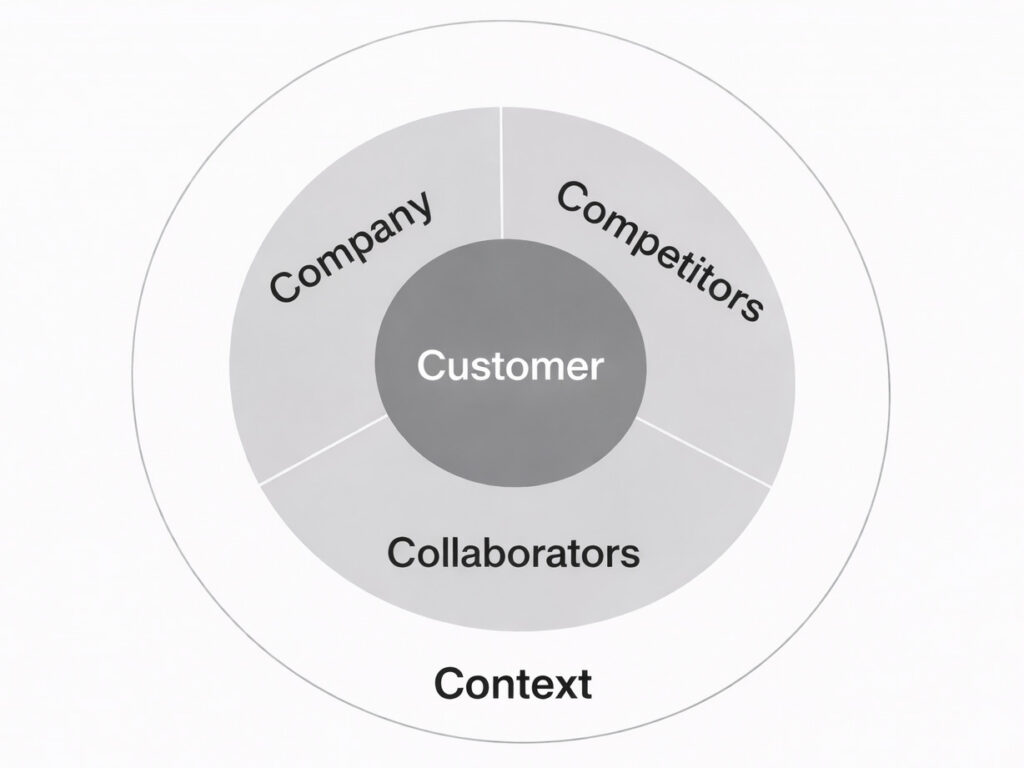
Using the five aspects of situation analysis² outlined below, this provides for the organising principle of a bank’s transformation which supports the bank’s vision:
- Customer Analysis
- Company Analysis
- Collaborator Analysis
- Competitor Analysis
- Context Analysis
Customer Analysis
The traditional client segmentation approach along age, income, location, and lifestyle, is a thing of the past.³ There are digital natives and crypto millionaires in their twenties who look for a trusted contact to manage their assets rather than traditional wealth managers.
At the same time, owners of cotton mills, manufacturers, traders and those in similar professions, now in their sixties and seventies, are ready to trade directly via digital platforms to manage their wealth. Their wish is for a quality platform provider and custodian, where they also can best leverage balance sheet products and networks.
Banks have started to look at hyper-segmentation to address their clients’ specific needs.
Company Analysis
This analysis looks at how ready a bank is to venture into or grow their wealth management business. They should identify the products that can be leveraged, and assess the gaps to serve the needs of a discerning clientele.
A further important aspect is the willingness of the management to exploit the opportunities given by the rising wealth creation. Are budgets and plans in place, or is there a vision for it?
Banks also need to define into which avenue the bank sees their path, and identify the game they plan to play in terms of set up, service and systems. This will be further expanded later in this article.
Collaborator Analysis
Traditionally, banks relied on either in-house product factories or external, specialist partners, i.e. brokers and fund houses for their non-balance sheet product offerings.
With the emergence of FinTechs, this segregation started to dilute.
Opportunities for banks to outsource products to a third party platform and integrate fast into their environment became an option for traditional houses that wanted to offer their clients access to a wider range of products. There are some successful models of this co-opetition. On the other hand, there is a high rate of failed initiatives, as EY⁴ and McKinsey⁵, amongst others, report.
A well designed framework of collaborators will help to deliver network effects.
Competitor Analysis
Based on market growth, we see all banks investing into their wealth management strategies. The challenge now is differentiation.
An offering designed around the 5P: Products, Places, Processes, Partners, and People, looking at novel approaches leveraging emerging technologies and coopetition could provide the differentiation, along with a marketing strategy leveraging the bank’s core values.
It is important to stay relevant, especially as more and more platforms are moving into traditional banking, thus claiming a piece of the growing pie.
Context Analysis
The economics for a push into wealth management are favourable, and the risks from geopolitical frictions currently favour Asia.
Technology is now readily available to implement new products and offerings in a cost effective and rapid way.
Furthermore, sociocultural, Asian clients trust incumbents; however, a younger group is looking at alternatives. Across the board wealth managers are testing out new platforms and are ready to source from the best in class, whether for credit, stock broking, digital and crypto assets, or alternative products.
3. Designing Your Strategy
In the dynamic landscape of wealth management, strategic design often gravitates towards traditional processes, particularly concerning KPIs and Client Servicing Models.
KPIs are often structured around two core objectives: “Beat the market” and “Do more with less.”
Beat the Market
This typically translates to achieving an AUM growth higher than x%. This figure is challenging to achieve. With wealth creation in Asia growing annually at 9%⁶, all banks are trying to surpass this figure.
Do more with less
This strategy suggests regional expansion, increased staffing, and process optimization to improve the cost-income ratio.
The opportunity here is to achieve quick wins with limited investments. But the downside is the existing operating model limits scaling.
In such an environment, how can a regional bank leverage its strong brand and local footing to tap into the rapidly growing affluent and private banking segments?
Across the region, the growing number of mass affluent investors is a key supporting factor, prompting a wave of technology-driven wealth management innovations that will also drive change in wealthier segments – particularly as wealth begins to transfer across the generations to digitally-savvy high-net-worth (HNW) and ultra-high-net-worth (UHNW) clients.
The external factors are favourable to grow the business. While some banks are successfully growing their franchise, others lag behind competitors.
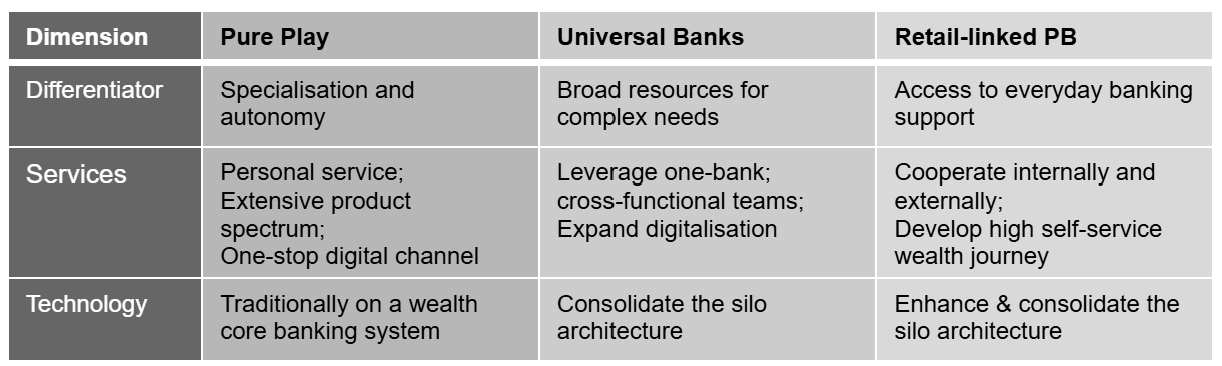
The Place – Define the Game You will Play
Wealth management today sits at a critical crossroads. The industry is under pressure from multiple directions: legacy system constraints, rising client expectations for seamless digital experiences, and the growing need to collaborate – or even compete – with FinTechs, WealthTechs and new wealth platforms, and challenger banks. The key question a CEO and her/his management team of a private banking franchise need to ask is:
What game do we want to play?
This can then translate into the vision statement.
Pure Play
Nothing prevents an existing bank from setting up a separate private bank – Bank of Singapore (arm of OCBC) serves as an example. The opportunity is to tailor the entity to the target clientele, without the ballast of a traditional bank, and especially its technology and other legacy systems. One factor to consider is how client transfer between the entities will work.
Universal Bank
An opportunity to provide a wide range of products and services in-house. Banks should focus on the role of a relationship manager as a conduit.
Retail-linked Private Bank or Wealth Management Business Unit
The advantages of this are to leverage automation and co-opetition for fast market access.
Markets
Questions to ask regarding markets include:
Should the design be different for the different markets the bank is present in? How could a cookie-cutter approach play out?
Can central functions be leveraged, from product management, to operations, to risk management?
Products
Banks must also define the products it wants to offer. There are two design principles that a bank may look at: One Bank, or Open Architecture.
One Bank
The “One Bank” concept has become a central proposition for private banks in Asia, being widely adopted by international banks such as UBS, Morgan Stanley, and Goldman Sachs, as well as by regional private banks.
“One Bank” is an often used term in private banks, nestled in global or regional universal banks.
Here are the benefits of “One Bank” and the challenges many firms face implementing it:
Benefits
- Keeps profits within the group
- Leverages dealmaking capabilities of the group to outpace competition
- One stop shop for wealthy customers
- Bespoke solutions
- Limited compliance efforts (once for the whole group)
Challenges
- Offering is limited by what the group has at present
- Fostering the silo architecture
- Uncompetitive pricing
- System integration challenges
Open Architecture
Whilst not completely the opposite of One Bank, its antithesis is Open Architecture.
What is true Open Architecture in Asia, and who is actually doing it? Hubbis⁷ published a thought article which summarizes the topic excellently:
In its purest form, open architecture refers to a platform or institution that provides clients with access to a wide universe of financial products and services – regardless of whether those products are manufactured in-house or externally.
Key principles of true open architecture include:
- Product neutrality – Advisors are not financially or operationally incentivised to favour in-house solutions
- Client-first philosophy – Product selection is based solely on suitability, quality, and alignment with the client’s objectives
- Breadth of access – A comprehensive range of third-party funds, discretionary portfolio management (DPM), structured products, insurance, and alternatives
- Advisory independence – Relationship managers (RMs) are empowered to build portfolios from across the global market without internal constraints
It is not said that the Open Architecture approach is avoiding the pitfalls of “One Bank”. A well-designed “One Bank” can deliver significant yields for customers and employees.
Very few institutions operate with architecture that is either fully open or fully closed.
Implementing an open architecture has a wide impact from how a bank remunerates their advisors, to how they source their solutions and products as well as select partners.
The Value of Co-opetition
With the emergence of technology partners, FinTech and WealthTech firms bring a new dimension to the design of Open Architecture. Identifying the right partners can create value in a networked economy.⁸
One possible pitfall is that technology can prevail over customer journeys. It is tempting to select an outsourcing or a technology partner and look at their features only. But the best value is achieved when the partner is selected based on a predefined framework:
- Was the customer journey white boarded end-to-end?
- How seamless is the journey and does it deliver exceptional experiences?
- What is the long term strategy with this partner?
- How to grow together?
- What is the remuneration model? Is there a (shared) revenue model? What incentives are built in based on performance?
- What is the exit path should the partnership go sour?
FinTech and WealthTech platforms not only offer new sleek access to a limited set of products, such as digital assets, or services, they are starting to move into mainstream banking.
This highlights a need to ring fence the bank’s client identifying data and ensure the relation remains professional.
A client portal/mobile app serving as a single point of access fully under the bank’s control is a technical measure to mitigate risks and ensure differentiation remains in a bank’s own hands.
4. Implementing Strategies of Wealth Managers and Regional Private Banking Units (Incumbents)
The traditional or conventional playbooks, such as more alignment, more communication, and more town hall meetings, aren’t enough for the pace, scale, and complexity organisations are dealing with nowadays.
What we’re seeing after years of transformation activities comes down to a few fundamentals.
Firstly, change must be treated as a capacity problem, not a messaging issue. Teams aren’t resistant; they’re saturated.
Secondly, real work doesn’t follow organisational charts. Every organisation operates on a shadow operating model, comprising informal decision paths, shortcuts, and trusted connectors. Ignoring that reality is why many transformations appear promising on paper but fail in practice. Gartner advocates that mixed teams, empowered to deliver change, are the most efficient as they leverage the shadow operating model.⁹
Thirdly, execution fails when the strategy is interpreted differently across functions. Translation, not alignment, is becoming the critical leadership muscle. The gap between intent and interpretation is where value disappears.
From Distribution to Advisory: The Challenge of Culture and Technology
Can Asian banks play a new game – where wealth and asset management is less about pushing products, and more about delivering on commitments that play out over many years?
The digital transformation presents significant challenges for incumbent banks and their wealth management units, who find themselves lagging behind more agile competitors. While digital financial platforms and neobanks are setting the technological pace, traditional banks struggle to keep up despite massive investments in modernization efforts. This gap stems from multiple deeply rooted obstacles: entrenched institutional cultures resistant to change, the inherent complexity of legacy business models built over decades, stringent regulatory frameworks that slow innovation, and a heightened awareness of both reputational and operational risks.
Additionally, risk avoidance behaviors – manifested at both organisational and individual levels – create institutional inertia that makes rapid adaptation difficult. These factors combine to create a significant disadvantage for traditional players in an increasingly digital marketplace, forcing them to balance the urgent need for technological advancement against the cautious prudence that has historically defined their operations.
Nonetheless, a number of banks are responding dynamically to the challenges. While Singapore’s wealth management firms are leading the digital transformation, banks in other Southeast Asian countries are also showing they can deploy new technology solutions rapidly.
5. Reimagining Wealth Management: The Courage to Transform
Transformation itself is a significant exercise. As the famous marketing professor John Paul Kotter has pointed out in his standard work Leading Change, a set of factors need to be in place for successful change.¹⁰
An excellent case study is DBS¹¹, which delivered “Making Banking Joyful” through three key tenets: (1) digital to the core; (2) being customer obsessed; (3) creating a start-up culture. This case illustrates the requisite leadership and operational capabilities to translate the digital transformation vision into a strategy.
The most important aspects for success are vision, available budget, management commitment, and the will to drive to completion. This approach facilitates solving the challenge of how to transition from product-push (sales) to client-centric advisory.
While traditional wealth management models will continue to evolve, the mass-affluent segment may increasingly shift toward new, tech-enabled operating models built for hyper-scale. Similar patterns have already reshaped industries such as e-commerce and mobile communications, and a comparable transformation now appears to be taking shape in the region’s wealth ecosystem.
The rise of digital universal banks and super-apps, exemplified by Revolut’s expanding footprint in Southeast Asia’s wealth and multi-currency markets, reflects a trend toward consolidated financial ecosystems offering everything from payment services to wealth advisory and investment products.¹²
In contrast to the “all-in one” value propositions, digital investment platforms with a focus on an asset class or service proposition are gaining ground. An Open Architecture approach will become a strategic imperative to integrate new products and services in time to market and stay ahead of competitors.
Open architecture will be essential as the wealth ecosystem expands and becomes increasingly complex. This evolution will demand robust integration frameworks – such as the Open Wealth API – to enable seamless collaboration among product and service providers and, more importantly, to deliver compelling value propositions for private and institutional clients.
Incumbents still benefit from the advantage of trust and confidence in their domestic markets, whereas foreign players – despite their cool image, mobile-first appeal, and often lower prices – tend to attract rationalists and internationally minded customers, but are less likely to become the preferred choice for a “house bank” relationship. In this light, Chinese private banks’ integrated cross-divisional approach to entrepreneur-oriented services offers a glimpse of transformative next-generation wealth management.¹³
As the wealth ecosystem and socio-economic landscape are evolving rapidly, standing still risks obsolescence. This is the moment to embrace change, to reimagine wealth management, and to lead with courage. The time for hesitation has passed – leaders must choose their play, define their vision, and act decisively to shape the future of their wealth management practice.
References:
- The Asia Generational Wealth Report 2025, UOB, November 2025: https://www.uob.com.sg/assets/web-resources/private/pdfs/our-insights/the-asia-generational-wealth-report/asia-generational-wealth-report-2025.pdf
- Strategic Marketing Management, Alexander Chernev, 10th edition, 2019, ISBN 978-0-9825126-3-0
- Kaizen Institute, Strategies for customer segmentation and personalisation in the banking sector: https://kaizen.com/insights/banking-sector-customer-segmentation/
- Ernst & Young, How banks can fix broken fintech partnership models, March 2023: https://www.ey.com/en_us/insights/strategy-transactions/how-banks-can-fix-broken-fintech-partnership-models
- McKinsey & Company: Why most digital banking transformations fail, April 2023: https://www.mckinsey.com/capabilities/tech-and-ai/our-insights/tech-forward/why-most-digital-banking-transformations-fail-and-how-to-flip-the-odds
- BCG, Global Wealth Report 2025, press release, June 2025: https://www.bcg.com/press/24june2025-organic-growth-advantage-financial-wealth-hits-record-high
- Hubbis, What is True Open Architecture in Asia, And Who is Actually Doing It?, June 2025: https://hubbis.com/article/what-is-true-open-architecture-in-asia-and-who-is-actually-doing-it
- Oliver Gassmann, Fabrizio Ferrandina, Connected Business: Creating Value in a Networked Economy, 2021: ISBN 978-3-030-76896-6
- Gartner, CIOs, Optimise Your Operating Model to Align IT and the Business Goals, webinar, June 2025: https://www.gartner.com/en/webinar/731065/1641950
- John P. Kotter, Leading Change, ISBN 978-1-4221-8643-5, 2012
- SMU Singapore Management University, DBS: Digital transformation to best bank in the world, case study, 2020: https://ink.library.smu.edu.sg/cases_coll_all/309/
- The Asian Banker, Revolut expands in Singapore and Southeast Asia with wealth and multi-currency services, Februar 2025: http://theasianbanker.com/updates-and-articles/revolut-expands-in-singapore-and-southeast-asia-with-wealth-and-multi-currency-services
- TAB Insights, Chinese private banks launch integrated entrepreneur-oriented services as market and regulatory pressures mount, March 2025: https://reports.tabinsights.com/article/chinese-private-banks-launch-integrated-entrepreneur-oriented-services-as-market-and-regulatory-pressures-mount



Comments are closed.