

Optimise sales performance with 5 KPIs
The practical guide to measurable sales success
Are you drowning in sales metrics and losing sight of the big picture? Here’s how to set your B2B sales up for success with just 5 KPIs. Simple, easy to understand and practical. Ready to get an overview? Then read on!
To cut a long story short: 5 KPIs are enough for top performance! – Sales is at the heart of every company. It is here that the decision is made as to whether the set goals will be achieved and whether the company will grow and flourish. However, the day-to-day work of a salesperson is complex: constantly changing market conditions, demanding customers, increasing competitive pressure. If you want to be successful in this dynamic environment, you need clear orientation and measurable results.
And this is precisely where KPIs come into play – key performance indicators that reflect the success of your sales activities. But be careful: too many key figures lead to confusion and inefficiency. The solution? The ‘rule of five’ from lean management. Focus on a maximum of five KPIs to sharpen your focus and maximise effectiveness. This approach may seem radical at first glance, but simplicity is the key to success, especially in the complex world of sales.
Index
Less is more: Why complexity in sales fails
Imagine you are standing in a dense jungle. Around you, nothing but trees, plants, sounds – an overwhelming abundance of information. You lose your orientation, the path to your goal disappears in the thicket. The same applies to too many KPIs in sales. You get bogged down in the details, lose sight of the big picture and end up making suboptimal decisions. A focused KPI system, on the other hand, is like a compass in the jungle.
💡 Practical Tip: Fewer KPIs don’t mean less knowledge, but more clarity and better decisions.
It provides a clear direction and leads unerringly to success. Studies in cognitive psychology show that a limited number of goals reduces cognitive load and promotes concentration. So fewer KPIs doesn’t mean less knowledge, but more clarity, more focus, more efficiency. By concentrating on the essential key figures, you create the basis for data-based decisions and sustainable growth.
The three essentials: revenue, profitability, customer satisfaction
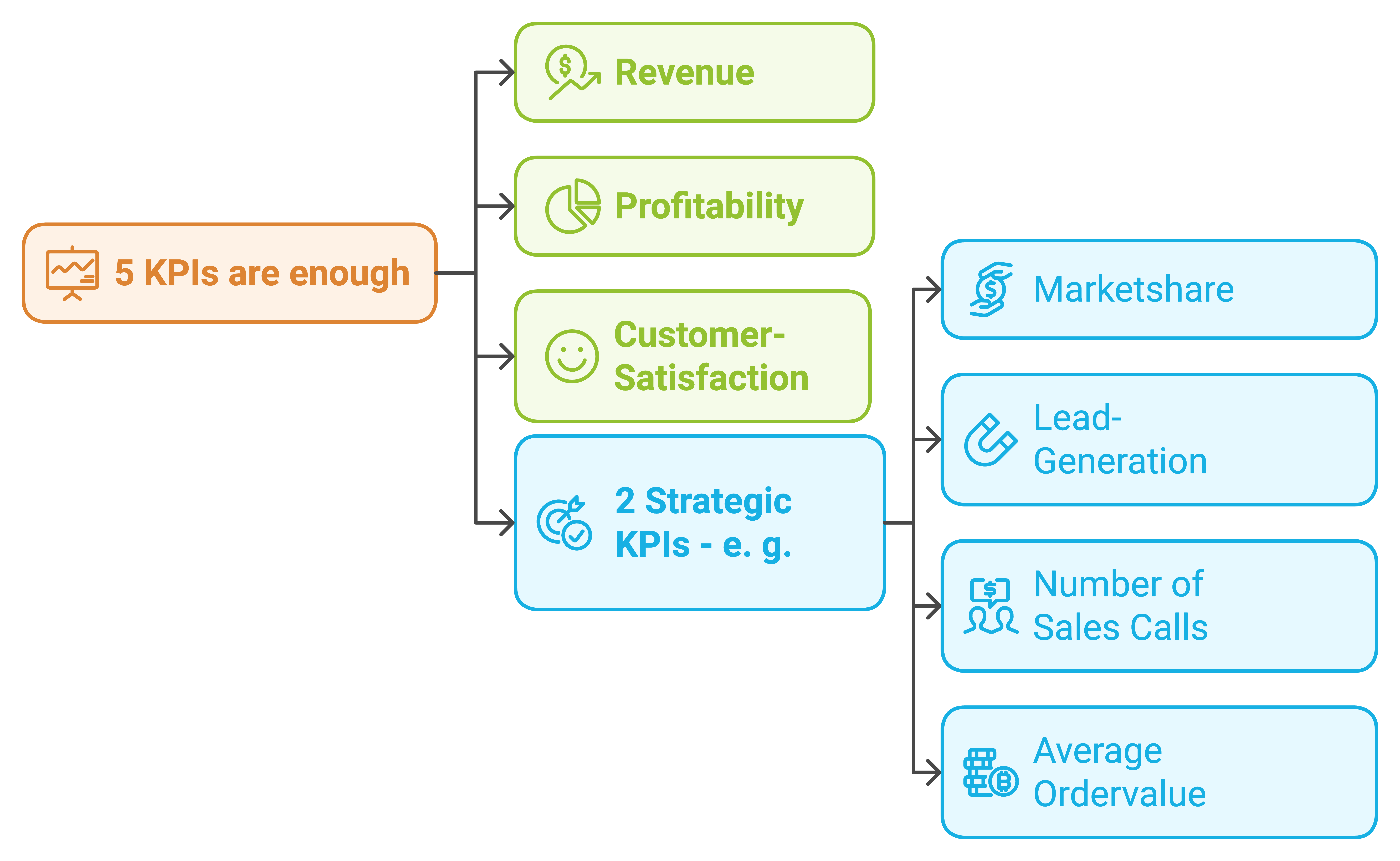
Every successful sales KPI system is built on three KPIs:
1. Revenue
The classic. Measures the direct financial success of your sales activities. But revenue alone is not meaningful. Granularity is important: analyse revenue by product group, region, customer segment and sales channel. This allows you to identify strengths and weaknesses, recognise growth potential and take targeted action. Set realistic but ambitious goals and monitor progress regularly – ideally monthly or even weekly.
2. Profitability
Sales are important, but profit is crucial. Profitability shows you how much money you are actually making. Take all cost factors into account: discounts, marketing costs, production costs, logistics costs. Analyse profitability by product group, customer segment, region and sales channel to understand the profitability of your activities. Optimise your processes to maximise your margins and ensure sustainable growth.
3. Customer satisfaction
Today, customer satisfaction is more than just a nice-to-have. It is the key to long-term success. Satisfied customers buy again, recommend you, and strengthen your brand. Measure customer satisfaction regularly using established methods such as the Net Promoter Score (NPS) or customer satisfaction surveys. Analyse not only the mean value, but also the distribution of responses and customer comments. This will give you valuable insights into your customers’ needs and expectations, enabling you to continuously improve your products and services.
The strategic 2: KPIs for your individual goals
In addition to the three basic KPIs, there are two further fields for flexible KPIs that you can select according to your individual goals and priorities. There are countless KPIs that you can use, but here are a few examples that I like to use:
– Market share
Do you want to expand your market position and become a market leader? Then market share is an important indicator of your success. Analyse the development of your market share compared to your competitors. Identify market segments with growth potential and develop targeted strategies to increase your market share. Also take into account external factors such as general market developments and the activities of your competitors.
– Lead generation
A strong sales pipeline is the basis for future success. The number of qualified leads shows you how effective your marketing and sales activities are. Measure the number of leads generated, the conversion rate of leads to opportunities, and the close rate of opportunities to customers. Optimise your lead generation processes to increase the number and quality of your leads and fill your sales pipeline. Use lead scoring models to prioritise the most promising leads and allocate your sales resources efficiently.
– Number of sales calls
This KPI measures the activity of your sales team. How many sales calls are made per week or month? What is the close rate per call? Analyse this metric to evaluate the effectiveness of your sales activities and identify areas for optimisation. Training and coaching can improve your team’s performance.
– Average order value
This KPI measures the value of each individual order. By increasing the average order value, you can boost your sales and profitability. Analyse the factors that influence the order value and develop strategies such as upselling and cross-selling to maximise the value of each transaction.
From theory to practice: the ‘Rule of Five’ in everyday sales
Selecting the right KPIs is just the first step. Implementing them in your day-to-day sales activities is just as important. This is where modern CRM and ERP systems provide valuable support. They enable the automated collection, analysis and visualisation of your key figures. Use dashboards, e.g. via Power BI, to keep an eye on the most important KPIs. Automated reports provide you with regular updates on developments and enable data-based decisions.
Actively involve sales staff in the process and make everything available responsively for smartphones and tablets. Transparency and participation boost motivation and strengthen the focus on common goals. Regular meetings to discuss KPIs promote the exchange of ideas and the identification of optimisation potential.
Control rhythms: The right rhythm for your success
The optimal frequency of KPI review depends on the respective key figure. Operational KPIs such as the number of sales meetings can be reviewed daily or weekly. Fundamental KPIs such as sales, profitability and customer satisfaction should be analysed monthly. Strategic KPIs such as market share are ideally reviewed quarterly. Adjust the control rhythms to your individual needs and regularly evaluate the effectiveness of your KPI system.
Checking too often leads to micromanagement and demotivates the team. Checking too rarely prevents timely intervention and leaves optimisation opportunities untapped.
💡 Practical tip: Checking KPIs too often leads to micromanagement and demotivates employees.
Clarity leads to sales success
An effective KPI system is not a straitjacket, but a flexible tool that helps you achieve your sales goals. The ‘Rule of Five’ offers a simple yet effective approach to reducing complexity and sharpening focus. With the right metrics, a clear strategy and the support of modern technologies, you can lay the foundation for sustainable sales success.
Remember: continuous optimisation is the key to long-term growth. Regularly analyse your KPIs, identify areas for improvement and adapt your system to changing market conditions. This is the only way to stay competitive and ensure your success in the dynamic environment of modern B2B sales.


Comments are closed.